Let’s discuss your container requirements
01708 225350
Call Us
sale@modularmarbles.com
Email Us

2026 Best PVDF Air Dome Manufacturers for Global Buyers

Choosing a reliable Pvdf Air Dome manufacturer takes more than comparing prices or browsing attractive project photos. Global buyers must assess material quality, structural design, production capacity, and support after installation. In 2026, these practical details matter as much as a supplier’s stated experience.

PVDF-coated fabric should come with clear technical data, including coating specifications, tensile strength, and expected service conditions. Ask how the manufacturer accounts for wind, snow, temperature changes, and the intended site. Request project references with comparable spans and climates, then verify what the supplier actually delivered. A detailed proposal should explain the membrane system, anchoring approach, ventilation, lighting, and maintenance requirements. Vague answers deserve follow-up. A polished brochure is not enough.

This guide introduces manufacturers for international buyers and outlines useful points for comparing them. It considers engineering capability, quality controls, customization, lead times, installation coordination, warranties, and communication across time zones. Buyers should also clarify shipping responsibilities, spare-part availability, and how service requests are handled once a dome is in use. No shortlist can guarantee a perfect fit; project needs vary, and supplier information should be checked directly. That takes time. Sometimes, the best choice is not the lowest quote, but the manufacturer that explains its limits clearly and documents its commitments.

2026 Best PVDF Air Dome Manufacturers for Global Buyers

Understanding PVDF Air Domes and Their Key Components

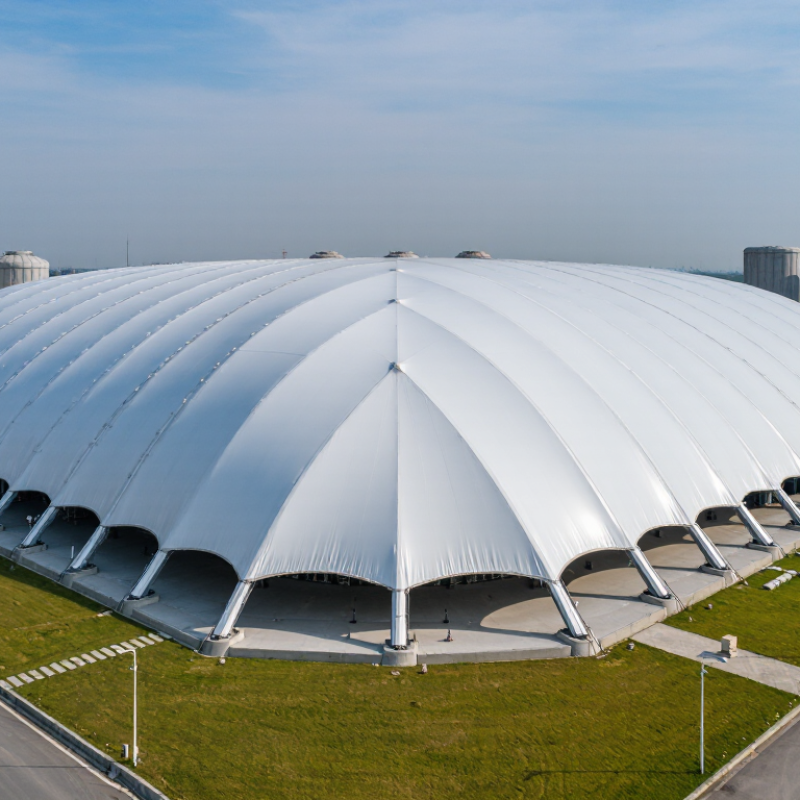
A PVDF air dome is an air-supported enclosure whose coated fabric membrane forms the roof and walls. PVDF usually serves as a protective surface finish, not as the structure holding the dome up. The membrane’s base fabric, coating thickness, seams, and installation quality all affect performance. Ask for documented material specifications and test results, rather than relying on the coating name alone. That detail matters.

The membrane connects to an anchoring system around the perimeter, which transfers wind and other loads into the foundation. Airlocks help people enter without causing a major pressure drop. Blowers maintain internal pressure, while backup power and controls help keep the enclosure operational during outages. Sensors can track pressure and temperature; ventilation and dehumidification manage comfort and condensation. Not glamorous, but essential.

In practice, inspect the membrane edges, door seals, and blower controls as carefully as the main roof area. These are useful places to spot wear or poor sealing. A specification sheet can still miss how the dome will perform at a particular site. Buyers should check that the proposed design, foundation, and operating equipment suit local weather and intended use, with qualified professionals reviewing the project.

How PVDF Air Dome Manufacturers Design and Build Their Systems

PVDF air dome systems begin with a site survey, not a fabric roll. Manufacturers assess ground conditions, wind exposure, snow loads, drainage, and intended use. These details shape the dome’s span, height, anchoring plan, and operating pressure. A design that works on a sheltered sports field may need changes on an exposed industrial site.

The enclosure typically uses engineered fabric with a PVDF finish, selected for weather resistance and cleanability. Teams calculate panel sizes and seam layouts before cutting and welding the material. Every seam matters. Poor alignment can create stress points, while inconsistent welding may weaken the envelope. Drawings, material records, and inspection checks help buyers verify how the system was made.

Air-handling equipment keeps the structure inflated, while sensors and controls respond to pressure changes. Manufacturers also plan for entry doors, emergency exits, backup power, and maintenance access. During installation, crews secure the base system, connect the fans, and test controls under operating conditions. Details differ by project, so buyers should request site-specific calculations and commissioning records. Specifications can look reassuring on paper; field conditions still surprise people. A careful review should leave room for adjustment.

Standards and Certifications for Global PVDF Air Dome Projects

For global PVDF air dome projects, certification should match the site, intended use, and local approval process. PVDF is a coating, not a complete structural specification. Buyers should review fabric strength, coating adhesion, tear resistance, seam performance, and documented fire behavior. Test methods such as ISO 1421 and ISO 2411 can help assess fabric tensile strength and coating adhesion. Details matter.

Ask for current test reports that identify the tested material, laboratory, method, and production batch. A report for a similar fabric may not represent the membrane being supplied. Check fire requirements carefully: accepted classifications differ by country and building use. Structural design documents should address local wind and snow loads, anchoring, emergency exits, and operating pressure. Test the seams.

A certificate folder alone cannot confirm that an installed dome meets project requirements. Compare the documents with drawings, material schedules, and installation records, then confirm whether local authorities require additional review. It is easy to overlook accessories; doors, ducts, and repair patches may affect performance too. Some standards leave room for interpretation, so buyers should record assumptions and ask for written clarification before ordering. That extra check can prevent costly surprises.

2026 Best PVDF Air Dome Manufacturers for Global Buyers — Standards and Certifications for Global PVDF Air Dome Projects
Evaluation Area Standard or Reference What It Covers Evidence to Request from a Manufacturer Global Buyer Check
Quality management ISO 9001 Quality management systems and processes; it is not a product certification for an air dome or membrane fabric. Valid certificate, certification scope, issuing certification body, and confirmation that the manufacturing site is covered. Verify certificate status and scope with the issuing body. Check that design, fabrication, inspection, and after-sales processes are within the stated scope.
Environmental management ISO 14001 Environmental management systems at an organization or site; it does not establish the environmental performance of a specific dome. Current certificate and site-specific scope; project-relevant information on waste, energy, and material handling where required. Confirm which legal entity and facility are covered. Do not treat this certificate as proof that a product is recyclable or low-carbon.
Occupational health and safety ISO 45001 Occupational health and safety management systems; it is not a structural safety approval for the completed building. Current certificate and the covered site or operational scope. Use as an organization-level qualification and separately review the project’s construction safety plan.
Building-code and permit compliance Applicable local building code; for example, the International Building Code (IBC) where adopted Local requirements for building classification, design loads, structural safety, fire provisions, permits, and inspections. Requirements depend on the jurisdiction and adopted code edition. Project-specific code-compliance matrix, design calculations, drawings, and documents prepared or reviewed by appropriately licensed local professionals when required. Confirm the governing code and authority having jurisdiction before design. A supplier’s general statement of compliance is not a substitute for local approval.
Wind actions ASCE/SEI 7 where adopted in the United States; EN 1991-1-4 where adopted in Europe Methods for determining wind actions on structures. These are design references, not standalone product certifications. Project-specific wind-load calculations, design assumptions, site parameters, anchorage reactions, and engineering review documents. Check basic wind speed, exposure or terrain category, topography, internal pressure assumptions, openings, and local code adoption.
Snow actions ASCE/SEI 7 where adopted in the United States; EN 1991-1-3 where adopted in Europe Methods for determining snow actions on structures, including relevant site and roof considerations. Project-specific snow-load calculations, assumptions for drifting or unbalanced snow where applicable, and operating procedures for severe weather. Check local ground snow data, exposure, thermal conditions, geometry, and any required snow-removal or operational plan.
Temporary-structure safety, when applicable EN 13782 Safety requirements for temporary structures, including certain temporary membrane structures. Applicability depends on the project type and local adoption. Statement of applicability, design documentation, inspection records, and evidence that the specific structure is designed for its intended use. Do not assume this standard covers every permanent air-supported building or replaces local building regulations.
Coated-fabric performance EN 15619 Requirements for coated fabrics used in temporary structures, within the standard’s defined scope. Fabric technical data sheet, test reports identifying the exact fabric construction, and confirmation of the intended application. Check whether the project and product fall within the standard’s scope. Verify the tested material matches the proposed fabric and production specification.
Flame propagation of textile materials NFPA 701 Test methods for flame propagation of textiles and films, including materials used in certain applications. Test report identifying the exact fabric, coating, color or construction where relevant, test method, and laboratory. Confirm that the local authority or project specification accepts the stated test method and that the tested sample is representative of the supplied material.
Reaction-to-fire classification EN 13501-1 Classification of construction products by reaction-to-fire performance under the applicable European test and classification framework. Classification report and supporting test documentation for the exact product configuration. European classifications and NFPA 701 results are not interchangeable. Confirm the required classification with the project’s authority and specification.
Fabric tensile strength ISO 1421 Methods for determining tensile strength and elongation of rubber- or plastics-coated fabrics. Test report with specimen direction, test method, conditioning details, results, and material identification. Review warp and weft results against the project specification; do not infer the performance of seams or the full dome from fabric tests alone.
Coating adhesion ISO 2411 Method for determining coating adhesion to textile fabrics. Test results for the proposed coated fabric, with product identification and test conditions. Check that the sample represents the specified substrate and coating system, and compare results with the project’s acceptance criteria.
Fabric tear resistance ISO 4674-1 Methods for determining tear resistance of rubber- or plastics-coated fabrics. Test report stating the method, specimen direction, results, and tested fabric construction. Confirm the selected test method and acceptance limits in the purchase specification; fabric tear results do not establish whole-structure capacity.
Air-supported system engineering Project-specific design and commissioning requirements Integrated performance of the membrane, anchorage, air-handling equipment, controls, backup power, access systems, and operating procedures. Design calculations, equipment schedules, pressure-control sequence, alarm and backup-power details, commissioning plan, inspection schedule, and operating manual. Evaluate the complete system rather than membrane data alone. Define design pressures, emergency response, maintenance responsibilities, and handover requirements in the contract.
PVDF material specification Manufacturer’s declared membrane construction and project specification PVDF commonly refers to a coating used on a textile substrate, often polyester; the term alone does not define the substrate, coating thickness, or complete fabric performance. Layer-by-layer product description, technical data sheet, batch traceability, test reports, warranty terms, and written confirmation of the proposed construction. Compare the exact fabric specification, not just the “PVDF” label. Verify that all test reports and warranty documents identify the product offered for the project.

Buyer note: This table is a standards and due-diligence checklist, not a ranking of manufacturers or a claim that any particular supplier holds these certificates. Standards, editions, and approval requirements vary by jurisdiction and project; confirm the currently adopted requirements with the local authority and qualified project professionals.

How to Evaluate PVDF Air Dome Manufacturers in 2026

2026 Best PVDF Air Dome Manufacturers for Global Buyers

How to Evaluate PVDF Air Dome Manufacturers in 2026

Evaluating a manufacturer starts with your site, not its brochure. Ask for PVDF-coated fabric specifications, including coating weight, tensile strength, tear resistance, and seam-welding test results. Request reports tied to the material batch, where available. A number without a test method is hard to compare. Check that weathering tests reflect your climate, especially strong sun, coastal air, or frequent freeze-thaw cycles.

Look closely at the engineering behind the dome. Ask how the design accounts for local wind and snow loads, ground anchors, air pressure, and backup power. Request clear design assumptions and independent engineering review where appropriate. Visit a completed project if possible. Inspect seams, entrances, airlocks, and signs of condensation. Ask about maintenance intervals and emergency procedures. A polished rendering proves little. Even a detailed proposal can leave questions unanswered.

Tips: Compare itemized scopes, warranty exclusions, spare-parts access, commissioning, and operator training. Speak with past clients about response times after installation. I would still leave room for doubt: one successful project cannot guarantee the same result at a different site.

Comparing Supplier Support, Installation, and Lifecycle Costs

For global buyers, a PVDF air dome is only as dependable as its engineering and support plan. Ask suppliers for project-specific wind and snow-load calculations, anchoring details, blower redundancy, and commissioning records. The membrane is visible; the service network is less so. Confirm who can inspect seams, ship repair materials, and respond when pressure alarms sound.

Installation quality affects cost for years. Request a written installation sequence, crew qualifications, and clear responsibility for foundations, electrical work, and local coordination. The 2024 Global Status Report for Buildings and Construction reports that buildings and construction used 32% of global energy and produced 34% of energy-related CO₂ emissions in 2022. That makes a modeled operating-energy estimate worth checking, not just a fabric specification. Details matter.

Compare lifecycle costs using the framework in NIST Handbook 135: include energy, routine maintenance, membrane repairs or replacement, and end-of-life value. Ask for assumptions behind service intervals and warranty exclusions. A low purchase price can hide costly freight, specialist labor, or prolonged downtime. Get it in writing. Real projects also encounter delays and imperfect site conditions, so leave contingency in the schedule and budget; supplier promises alone are not a maintenance plan.

2026 Best PVDF Air Dome Manufacturers for Global Buyers

Comparing supplier support, installation, and lifecycle costs

Example buyer-defined evaluation weights, not supplier ratings or market benchmark data. The criteria reflect common procurement considerations; adjust the percentages to match project requirements and compare documented supplier proposals.

We are proud to support

Registered Company Name: Upminster Containers Limited. Registered Address: Mardyke Works, St Mary's Lane, Upminster, Essex RM14 3PA. Registered Company Number: 00940382
Developed & Maintained By Space Rocket Digital.
chevron-down