Choosing the right Backlit letters sign supplier in China requires more than comparing online prices. The supplier must understand lighting, materials, fabrication, packaging, and installation conditions. A polished website proves very little.
Sign-industry designer Dan Antonelli describes signage as “your silent salesperson.” That idea matters here. Your sign represents the business before a customer enters the building. Uneven illumination, weak returns, or visible wiring can damage that first impression.
Look for suppliers with proven project experience. Ask for factory videos, material samples, production drawings, and completed installation photographs. Check whether the acrylic faces remain evenly lit at night. Examine aluminum edges, letter depth, LED spacing, cable exits, and waterproofing details. Small details become expensive problems later.
A reliable supplier should explain LED brands, color temperature, power consumption, transformer capacity, and expected service life. They should also provide clear warranties and replacement procedures. Do not accept vague promises.
Ask for a sample letter.
It reveals more than a brochure.
Request a pre-production drawing with exact dimensions, fixing points, colors, and logo proportions. Confirm the packing method before production begins. Damaged corners and scratched faces are common, avoidable failures.
Price still matters, but the lowest quote may exclude mounting hardware, testing, or secure export packaging. That comparison can mislead you. A better evaluation considers total cost, communication speed, quality control, and after-sales support.
No supplier is perfect. Even experienced factories can misunderstand a color reference or installation surface. Careful buyers leave room for verification, correction, and honest questions. This guide explains how to assess Chinese suppliers with practical evidence, not attractive claims.
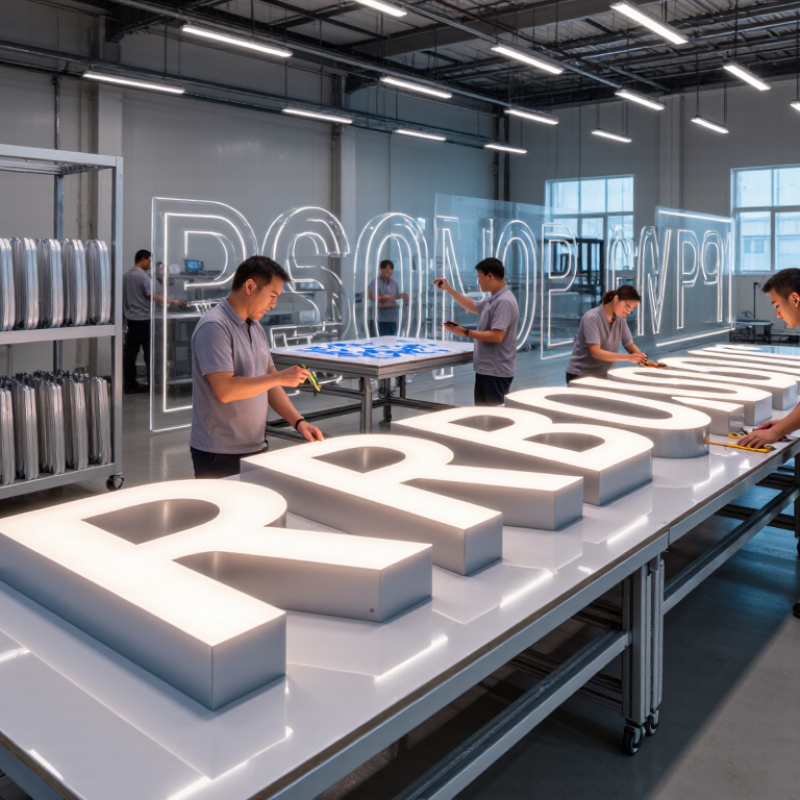
Before contacting a supplier, describe your sign as clearly as possible. Include the letter height, total length, viewing distance, and installation location. A lobby sign needs different lighting from an outdoor building sign. Specify the front material, return depth, finish, and preferred color temperature. Warm white creates a softer appearance, while cool white looks sharper. Also confirm the required voltage, lighting method, waterproofing level, mounting system, and cable position.
A professional requirement sheet reduces misunderstandings during quotation and production. Add drawings, reference photos, or a simple wall sketch when available. Ask for production samples, material details, wiring diagrams, and quality inspection photos. You should also state your target delivery date, packaging expectations, and destination port. These details help a Chinese supplier calculate costs more accurately. Cheap pricing can hide thinner metal, uneven illumination, or weak mounting parts. That risk deserves attention.
Tips: Measure twice. Mark the cable exit clearly. Request a dimming test if brightness matters. Confirm color samples before production. Leave time for revisions, because even a small spacing error can change the whole sign’s appearance. A common mistake is approving a digital drawing without checking its real scale. Ask how the supplier handles defects, replacement parts, and installation questions after shipment. Clear answers show practical experience and reliable communication.
How to Find the Best Backlit Letters Sign Supplier in China?
Research China-Based Sign Suppliers and Their Capabilities
Finding a capable China-based sign supplier requires more than comparing online prices. Study each supplier’s production experience, workshop equipment, and project history. Ask for recent photos of backlit letters, not only polished catalog images. A real workshop should show cutting, welding, painting, and LED installation areas.
Request material details in writing. Check the aluminum grade, acrylic thickness, stainless steel finish, LED type, wiring method, and waterproofing process. Ask how the supplier controls brightness across large letters. Uneven lighting is a common problem. Request sample photos taken in darkness and daylight. Better still, order a small prototype before approving a complete order.
Factory verification also matters. A video call can reveal useful details, but an independent inspection gives stronger evidence. Review quality records, packaging methods, production schedules, and replacement procedures. Ask for test reports that match your destination market’s requirements. Reliable suppliers should explain electrical specifications clearly, without avoiding difficult questions.
My early mistake was trusting a low quotation too quickly. The letters looked attractive, but the mounting hardware was poorly explained. That delayed installation. I now compare technical drawings, tolerances, carton protection, and installation guides before discussing price. Communication quality is part of supplier capability. Notice how quickly the team answers, whether drawings contain errors, and if promised changes appear in updated documents. Small details often predict larger production problems.
Research China-based sign suppliers by comparing documented capabilities across customization, outdoor durability, prototyping, export documentation, and delivery consistency. The normalized scores below are a practical research benchmark rather than company-specific data.
Higher scores indicate stronger documented capability in that evaluation area. Before selecting a supplier, verify certifications, material specifications, lighting tests, production samples, quality-control procedures, and delivery terms directly.
Choosing a Chinese backlit-letter supplier starts with materials, not a glossy catalog.
For outdoor signs, inspect aluminum grade, return depth, acrylic thickness, and drainage paths. Stainless steel creates a refined edge, but aluminum usually reduces weight and corrosion risk. Acrylic diffusion must remain even across the face. Thin sheets may reveal bright LED dots at night.
The U.S. Department of Energy’s 2023 Solid-State Lighting R&D Opportunities report identifies efficacy, color quality, and thermal management as major industry priorities. Ask for LED bin information, color-temperature tolerance, and heat-test records.
“High brightness” is not a specification.
Design should support distance, viewing angle, and installation conditions. Request physical samples with your actual letter height and color values. A Sign Research Foundation study, based on University of Cincinnati research, reported an average 4.75% sales increase after on-premise signage improvements. This is useful direction, not a promise.
Excessive glow can reduce legibility. I would test the sign at dusk, in rain, and from the road.
Indoor showroom lighting can hide weak diffusion.
Production quality appears in small details. Check welded corners, cable glands, screw alignment, and paint consistency. Ask for waterproof testing against IEC 60529 requirements, especially for exposed installations.
Review illuminated samples for at least eight hours. LEDs may look uniform initially, then reveal thermal differences. A factory audit should include incoming-material records, aging-test photos, and final inspection sheets.
I once trusted a perfect prototype too quickly. Mass production can still expose uneven spacing or loose wiring.
How to Find the Best Backlit Letters Sign Supplier in China?
Finding a suitable backlit letters sign supplier starts with comparable pricing. Ask for an itemized quotation. It should list aluminum grade, LED modules, acrylic thickness, transformers, packaging, and shipping terms. A low price may hide thinner returns or weak waterproofing. Request a physical sample when possible. Small details matter.
Check certifications carefully. Depending on your market, relevant documents may include CE, RoHS, ISO, or electrical safety reports. Ask for certificate numbers, issuing bodies, and validity dates. A PDF alone is not proof. Confirm whether testing covers the complete sign or only individual components. This step requires technical judgment, not just paperwork.
Lead times should separate artwork approval, sampling, production, and dispatch. For custom letters, 15 to 25 working days may be realistic, while special finishes require longer. Ask about holiday closures and inspection schedules. Written milestones reduce confusion. Services also deserve comparison. Look for CAD review, lighting advice, installation files, spare LEDs, export packaging, and responsive after-sales support. Confirm warranty terms and replacement responsibilities. A common mistake is accepting a fast promise before checking the artwork. That promise may fail. Even careful buyers can overlook rework costs, so leave a modest contingency in the budget.
| Supplier Profile | Typical Product Configuration | Indicative Price (USD/letter) | Typical MOQ | Production Lead Time | Quality and Certification Evidence | Customization Capability | Export and Support Services | Best Fit |
|---|---|---|---|---|---|---|---|---|
| Profile A Entry-level factory | 304 stainless-steel face, acrylic back, standard white LED modules, 60–80 mm return depth | $22–$38 | 10–20 letters | 12–18 working days after artwork approval | Material reports and LED test records; compliance documents generally supplied per project | Standard fonts, colors, mounting studs, and cable exits | Export cartons, installation drawings, photo inspection before shipment | Small trial orders and cost-sensitive projects |
| Profile B Mid-range OEM supplier | 304 stainless steel or aluminum face, acrylic back, waterproof LED modules, 80–100 mm return depth | $32–$55 | 5–10 letters | 10–15 working days after drawing confirmation | Factory quality-control checklist, LED electrical test, grounding inspection, and material certificates on request | Custom logos, Pantone color matching, halo brightness control, and mixed letter depths | Production samples, assembly diagrams, spare LED modules, and consolidated shipping | Retail chains, hotels, and repeat OEM orders |
| Profile C Premium architectural fabricator | Brushed or powder-coated stainless steel, concealed LED system, reinforced aluminum back, 100–150 mm return depth | $55–$95 | 1 complete sign set | 18–28 working days, including prototype approval | Documented incoming inspection, light-uniformity test, water-resistance test, and project-specific compliance file | Complex typography, large-format letters, dimming systems, curved forms, and architectural finishes | Shop drawings, structural fixing details, installation guidance, crating, and project coordination | Hotels, headquarters, premium retail, and architectural projects |
| Profile D Fast-turnaround manufacturer | Aluminum or stainless-steel channel letters, standard white or warm-white LED modules, 60–90 mm return depth | $28–$48 | 10 letters | 7–12 working days for standard designs | Routine illumination and insulation checks; certificates depend on selected components and destination market | Limited custom finishes; strong support for standard fonts and repeat designs | Express production scheduling, digital proofing, protective foam packing, and shipment photos | Short-deadline replacements and standard commercial signage |
| Profile E Project-management supplier | Custom stainless-steel or aluminum letters, programmable or static LED options, optional power supplies and mounting systems | $42–$78 | 1 project or 5–10 letters | 15–25 working days, depending on engineering scope | Inspection records, electrical documentation, material declarations, and destination-specific files when available | Brand guideline implementation, multilingual artwork, modular mounting, and site-specific adaptations | Single-point coordination, sample approval, export documentation, container consolidation, and after-sales support | Multi-site rollouts and international signage programs |
A polished website does not prove manufacturing ability. I have learned this after comparing sign samples, factory photos, and production records. Ask each supplier for a business license, workshop address, equipment list, and recent project references. Request close-up photos of letter edges, acrylic faces, LED modules, wiring, and mounting parts. These details reveal workmanship more clearly than promotional images.
Check whether the supplier can match your drawings, dimensions, color requirements, brightness level, and installation method. Ask for material specifications, lighting tests, packaging photos, and a written production schedule. A reliable team should explain tolerances, waterproofing methods, power requirements, and quality inspection steps. Request a physical sample when the order is complex. It costs more, but mistakes cost more. No verification process is perfect.


