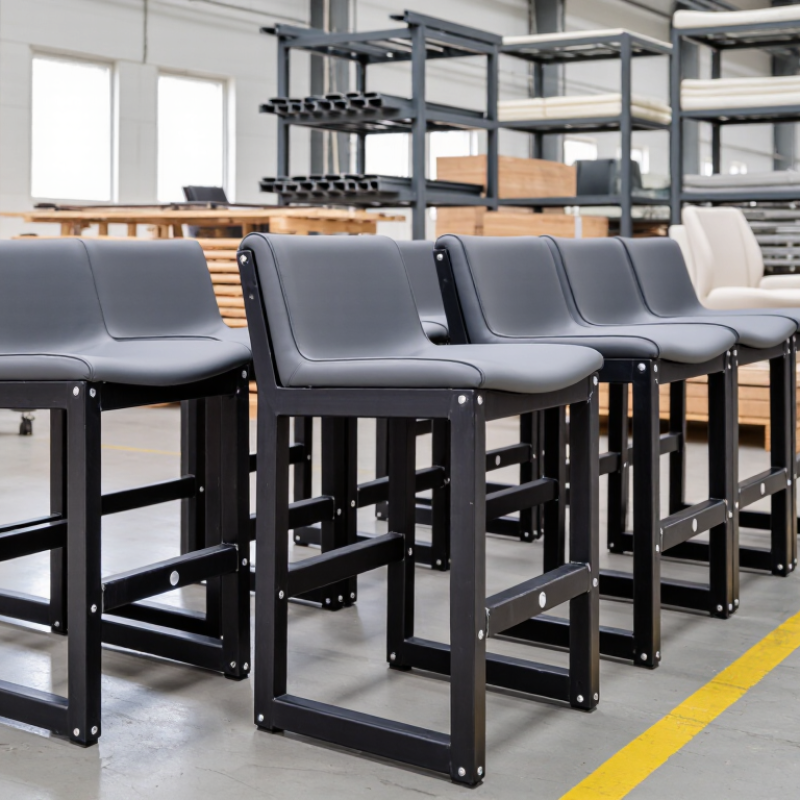
Choosing the best Industrial Counter Stool supplier in China requires more than comparing catalog prices. Commercial buyers need dependable frames, repeatable finishes, documented testing, and responsive communication. A stool may look strong in a showroom, yet fail after repeated loading, transport, or cleaning.
The global furniture market continues to expand. Grand View Research reported a global furniture market value of approximately US$652 billion in 2023, with continued growth expected through 2030. This growth increases supplier competition, but it also makes verification more important. China remains a major furniture manufacturing and exporting base, supported by mature metalworking, welding, powder-coating, and logistics networks. UN Comtrade data also shows China’s strong position in furniture-related international trade.
Price alone is a weak filter. It can hide thinner steel tubing, inconsistent weld penetration, unstable footrests, or limited quality control. Look for suppliers who provide material specifications, load-testing records, factory photos, and clear inspection procedures. BIFMA performance principles and relevant commercial seating standards can help buyers compare durability and safety expectations, even when local requirements differ.
Experience matters here. A reliable factory should explain tube thickness, foam density, coating performance, packaging protection, and replacement-part support without vague promises. Ask for production samples, not only digital renderings. Check whether the same stool survives several inspection rounds.
No supplier is perfect. Even an experienced factory may face delays, color variation, or unexpected mold changes. The better partner is transparent about these risks and corrects them quickly. This guide examines the evidence behind supplier selection, from factory capability and certification to customization, lead time, and long-term service.
A high-quality industrial counter stool supplier is defined by consistent manufacturing, not attractive catalog photos. In China, serious suppliers explain their steel grades, wood moisture levels, and surface treatments clearly. They should provide drawings with seat height, footrest position, base width, and weight limits. Small measurement errors can make a counter stool uncomfortable or unsafe.
Factory experience matters. Ask how welds are inspected, how powder coating is tested, and how production defects are recorded. A dependable supplier welcomes sample approval before mass production. The sample should reveal joint strength, edge finishing, balance, and noise during use. It is not enough to promise durability. Test reports, inspection records, and material traceability offer stronger evidence.
Communication also defines quality. A reliable team confirms specifications in writing and reports delays before they become expensive. Packaging should protect corners, painted surfaces, and wooden components during long transport. Some suppliers perform well but respond slowly when designs change. That weakness deserves attention. No factory is perfect, and even experienced teams can overlook a detail. A careful supplier admits problems, proposes corrective action, and keeps the buyer informed. This practical honesty often separates a trustworthy industrial counter stool supplier from a merely capable manufacturer.
A reliable China industrial counter stool supplier should be judged by materials and manufacturing evidence, not catalog photos.
Powder-coated carbon steel offers strong load resistance and easier repair. Aluminum reduces weight and resists corrosion, but softer frames may deform under repeated impacts.
The International Aluminium Institute reports that recycling aluminum can save up to 95% of the energy used for primary production.
For seats, molded plywood, solid hardwood, and high-density polypropylene each suit different environments. Check moisture resistance, edge finishing, weld penetration, and upholstery abrasion results. A beautiful surface can still hide weak joints.
Manufacturing standards deserve equal attention. Ask for test reports based on GB/T 10357.3 for chair and stool mechanical properties, or EN 16139 for non-domestic seating where relevant. ISO 7173 testing can help verify strength and durability.
ISO’s 2022 survey recorded more than 1.2 million ISO 9001 certificates worldwide, yet certification alone does not prove consistent stool quality. Request batch traceability, incoming material records, welding inspections, load testing, and corrective-action reports. I would also inspect random samples. One sample is never enough.
Tips:
Confirm the rated load, test duration, safety factor, and intended floor type. Ask whether the result covers the exact model, not a similar frame. Compare three production batches when possible. In practice, suppliers may provide incomplete documents. That is a warning, not a minor inconvenience. Also evaluate packaging compression, replacement parts, and finish consistency after salt-spray testing. These details often decide whether a stool survives a busy café, workshop, or commercial counter.
What Is the Best China Industrial Counter Stool Supplier?
How to Compare China’s Industrial Counter Stool Manufacturers
China’s industrial counter stool market offers many capable factories, but price alone is a weak filter. CSIL’s World Furniture Outlook 2024 valued global furniture consumption at more than US$1.5 trillion, showing intense competition across suppliers. Compare manufacturers through evidence, not polished catalog images. Request material certificates for steel grades, wood moisture, and coating performance. A reliable factory should explain its process clearly.
Ask for a pre-production sample. Inspect weld penetration, hidden sharp edges, seat balance, and the smoothness of the footrest. During factory visits, I check whether production records match the approved sample. Small differences matter. A stool that rocks on a showroom floor may create costly returns. Review test reports against ANSI/BIFMA X5.4, which covers commercial stool stability, strength, and durability. Also verify carton drop tests, load-test procedures, and inspection photos from the actual batch.
Tips: Compare at least three factories using the same specification sheet. Record MOQ, sample fees, lead time, spare parts, and replacement policies. Ask for recent third-party inspection records. Do not accept generic certificates. Check the issuing laboratory and test date. A 30-day warranty sounds useful, but its coverage may be vague. Clarify it in writing. I would also order a small pilot batch before a full container. It costs more initially, yet one overlooked weld can cost much more later.
What Is the Best China Industrial Counter Stool Supplier?
Choosing a China industrial counter stool supplier requires more than comparing prices. Customization should begin with clear drawings, seat height, frame dimensions, and material specifications. A reliable supplier can adjust steel thickness, footrest position, seat shape, and powder-coat color. Small details matter. A two-millimeter height difference can affect comfort across a busy counter.
My practical checks include reviewing pre-production samples and testing the actual finished stool. Inspect weld consistency, level feet, coating coverage, and hidden sharp edges. Ask for load-testing records, incoming material checks, and final inspection photos. I once focused too heavily on a polished sample and overlooked weak packaging. That mistake caused avoidable damage during shipping. Supplier quality is never perfect by assumption.
Tips: Request one customized prototype before placing a large order. Confirm tolerances in writing. Ask how rejected parts are recorded and corrected. If a supplier avoids specific answers, pause.
Certifications should match your sales market and product use. Review current factory certifications, test reports, and their issuing organizations. ISO 9001 can indicate a documented quality system, but it does not prove every stool is excellent. For commercial seating, relevant strength, durability, flammability, or chemical tests may matter. Check whether reports cover the exact model, materials, and production site. Some suppliers present old documents. That deserves careful questioning. A dependable partner welcomes third-party inspections and provides traceable batch records.
| Evaluation Dimension | Practical Requirement for an Industrial Counter Stool | Recommended Benchmark or Range | Verification Evidence to Request | Why It Matters |
|---|---|---|---|---|
| Seat Height | The seat should match the working surface and allow comfortable leg clearance. | Counter height: approximately 610–685 mm (24–27 in); bar height: approximately 710–840 mm (28–33 in). | Dimensioned technical drawing, approved sample, and final inspection report. | Incorrect seat height reduces comfort and can create poor posture during extended use. |
| Frame Material | Use a material suitable for commercial traffic, cleaning routines, and the intended indoor or outdoor environment. | Powder-coated carbon steel for indoor use; stainless steel or corrosion-protected steel for demanding environments. | Material declaration, mill certificate where applicable, coating specification, and corrosion-test results when required. | Material selection affects strength, corrosion resistance, appearance, and service life. |
| Tube and Plate Thickness | Structural dimensions should be engineered for the stool design rather than selected only for appearance or low cost. | Common steel tube wall thicknesses may fall around 1.2–2.0 mm, subject to design calculations and testing. | Engineering drawings, incoming material inspection records, and sample cross-section measurements. | Consistent thickness helps control frame rigidity, weight, weld quality, and durability. |
| Load Capacity | The rated load should be supported by a recognized test method and should reflect repeated commercial use. | A stated static load rating of at least 120–150 kg is a useful procurement reference, subject to the applicable standard and design. | Third-party or witnessed test report covering static strength, durability, and stability. | A clear, tested rating reduces safety risks and supports consistent product specification. |
| Relevant Product Standards | Testing should match the stool’s use location, such as hospitality, commercial, public, or residential use. | Possible references include EN 16139 for non-domestic seating, EN 12520 for domestic seating, or applicable ANSI/BIFMA seating standards. | Complete test report identifying the exact model, configuration, test method, laboratory, and result. | A certificate for a different product or configuration may not validate the supplied stool. |
| Welding Quality | Welds should be continuous where structurally required, free from visible cracks, and properly finished. | No sharp edges, incomplete fusion, excessive spatter, visible porosity, or unstable joints in inspected areas. | Welding work instructions, operator qualifications where applicable, first-piece approval, and visual inspection records. | Poor welding can cause wobble, premature failure, injury hazards, and inconsistent production quality. |
| Surface Finish | The finish should be uniform, well bonded, and suitable for the cleaning chemicals used at the installation site. | Specify color reference, gloss level, coating system, edge coverage, and corrosion-performance requirement before production. | Approved color sample, coating technical data sheet, adhesion test, thickness measurement, and corrosion test when specified. | A controlled finish improves appearance consistency and protects the frame from wear and corrosion. |
| Seat and Upholstery Options | Seat materials may include solid wood, plywood, molded plastic, metal, leather, or synthetic upholstery. | Define seat thickness, foam density where applicable, fabric performance, edge radius, and cleanability requirements. | Material samples, supplier declarations, abrasion or colorfastness data, and a production-approved reference sample. | The seat is the main user-contact surface and strongly affects comfort, hygiene, and replacement cost. |
| Customization Capability | The supplier should support changes to dimensions, frame geometry, seat materials, finishes, footrests, stacking, and packaging. | Require drawings, 3D files or samples, change-control records, and a documented approval process before mass production. | Engineering capability statement, prototype records, tooling quotation, and signed technical specification. | Controlled customization prevents design changes from weakening safety, fit, or production consistency. |
| Dimensional Quality Control | Critical dimensions should be measured during production, not only after the order is completed. | Use agreed tolerances for seat height, overall width, frame alignment, footrest position, and hole locations. | Inspection plan, calibrated measuring tools, in-process records, and final inspection sampling results. | Dimensional control ensures stools fit counters, tables, packaging, and installation layouts. |
| Stability and Floor Protection | The stool should stand level and resist tipping under normal user movement. | Specify leg geometry, adjustable glides if needed, non-marking feet, and the required stability test method. | Stability test results, flat-floor inspection, glide material specification, and packaging protection review. | Stable seating improves user safety and helps prevent damage to finished flooring. |
| Factory Quality System | A repeatable quality system should cover purchasing, production, inspection, corrective action, and traceability. | ISO 9001 certification is a useful quality-management reference when the certificate scope covers the relevant manufacturing activities. | Valid certificate, certification scope, issuing body, audit status, quality manual summary, and corrective-action records. | A management system supports consistency but does not replace product-specific testing and inspection. |
| Environmental Management | The supplier should control waste, chemical handling, energy use, and environmental compliance relevant to the factory. | ISO 14001 may be requested when environmental management is part of the buyer’s procurement policy. | Valid certificate, scope, environmental permits where applicable, and material or packaging declarations. | Environmental controls help support regulatory compliance and responsible sourcing objectives. |
| Pre-Shipment Inspection | Finished goods should be checked for quantity, dimensions, appearance, function, packaging, and labeling before dispatch. | Use an agreed acceptance quality limit, inspection level, defect classification, and inspection checklist. | Inspection report with photographs, sampling details, defect records, and corrective-action confirmation. | Independent or buyer-approved inspection reduces shipment disputes and costly rework. |
| Packaging and Transit Protection | Packaging should protect corners, painted surfaces, upholstery, and moving parts during handling and ocean or road transport. | Specify carton strength, internal protection, palletization, moisture control, drop-risk areas, and recyclable materials where required. | Packaging drawings, transit test or shipping trial, carton markings, and loading photographs. | Effective packaging prevents cosmetic damage and lowers replacement and claims costs. |
| Best Supplier Selection Method | Select based on verified technical capability, quality evidence, communication, total landed cost, and after-sales support. | Compare at least three qualified suppliers using the same specification, sample, test plan, and scoring weights. | Completed supplier questionnaire, factory audit, sample evaluation, quotation comparison, and reference-order performance. | The lowest unit price does not necessarily provide the lowest total cost or lowest supply risk. |
The best China industrial counter stool supplier is not automatically the cheapest quote. A reliable supplier should prove control from tube cutting to export packing. The ISO Survey 2023 recorded 1,265,216 ISO 9001 certificates worldwide, but certification alone cannot verify stool quality. Request the certificate scope, issuing body, expiry date, and factory address. Then compare them with the production site. A mismatch is a warning.
Ask for a production sample before approving a large order. Measure seat height, base diameter, frame thickness, and foot-ring position. Inspect weld penetration, burr removal, coating thickness, and alignment under bright light. Do not trust polished photos. For a 750 mm counter stool, require documented load and durability tests suited to intended use. Applicable ANSI/BIFMA or EN seating requirements should be identified clearly. Request material certificates for steel and plywood. This catches substitutions. A pilot order reveals defects.
Audit the supplier’s actual workshop, not only its showroom. Check incoming inspection records, calibration labels, defect logs, corrective actions, and worker instructions. The World Bank’s 2023 Logistics Performance Index ranked China 19th overall, yet national logistics performance cannot prove one factory’s delivery reliability. Track carton compression, moisture protection, assembly time, and repeated defects. I would ask one uncomfortable question: what happens when the first batch fails? A serious supplier provides a written remedy, timeline, and responsible contact. Some factories answer well but document poorly. That weakness deserves caution.