Choosing the right Custom Rubber Springs Supplier can influence product safety, service life, and total procurement cost. This guide introduces seven suppliers serving global buyers across industrial equipment, automotive systems, medical devices, and vibration-control applications. Our comparison focuses on practical evidence, not polished marketing claims. We examine rubber compounds, spring geometry, load capacity, compression behavior, temperature resistance, and manufacturing tolerances.
A reliable supplier should explain how its products perform under repeated loads, oil exposure, humidity, and changing temperatures. Samples, technical drawings, inspection reports, and traceable material information can reveal more than a sales brochure. Details matter. We also consider communication speed, engineering support, minimum order quantities, packaging, lead times, and export experience. A supplier may offer excellent molding quality yet struggle with documentation or overseas delivery. That weakness deserves attention.
The selected companies represent different strengths, including custom design, rapid prototyping, high-volume production, and specialized rubber formulations. We encourage buyers to request samples and test them under real operating conditions. Fit changes everything. A spring that performs well in a laboratory may behave differently inside a vibrating machine with heat, dust, and misalignment. No supplier is perfect, and our ranking should not replace your own qualification process. That caveat matters. Buyers should confirm current certifications, regulatory documentation, warranty terms, and after-sales support before placing an order. With careful comparison, this list can shorten research time and support a more dependable purchasing decision.
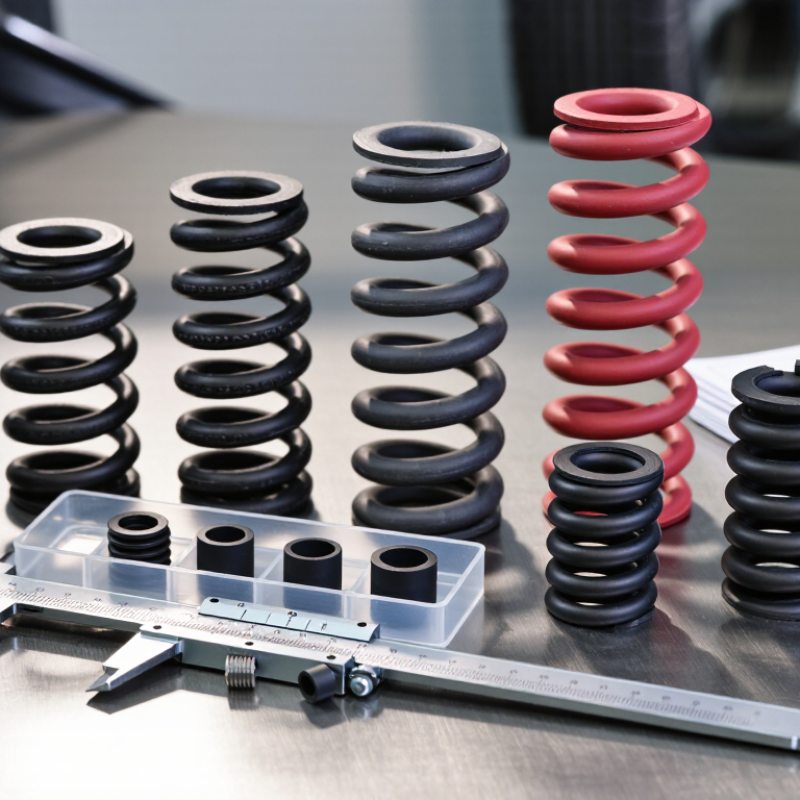
Custom rubber springs combine elastic recovery, load support, and vibration control. Shore A hardness usually ranges from 40 to 90. Softer compounds suit light loads and larger deflection. Harder compounds support greater force with less movement.
A practical design starts with load, travel, temperature, and installation space. For example, a 40 Shore A spring may compress visibly under hand pressure. A 90 Shore A part feels firm and transfers more vibration. Deflection is not linear in every shape. Diameter, height, bonding, and compression ratio can change the result. ASTM D2240 defines Shore hardness testing, while ISO 815-1 evaluates compression set. These tests help buyers compare supplier data more reliably.
Damping depends on compound formulation and operating frequency. ISO 4664-1 describes dynamic testing for rubber materials. Buyers should request force-deflection curves, hysteresis data, and fatigue results at the actual temperature. A 2024 global rubber market assessment estimated the sector at roughly USD 46 billion in 2023, showing the scale of industrial demand. However, market size does not guarantee spring quality. I would treat catalog values as starting points, not final design proof. Real assemblies often behave differently after aging, oil exposure, or uneven loading. That detail is easy to miss.
Choosing a custom rubber spring supplier requires more than comparing online catalogs. I check whether the supplier holds a current ISO 9001 certificate. The certificate should cover the actual manufacturing site, not only a parent office. I also request recent audit records, batch traceability, and a sample inspection report.
ASTM D395 data helps evaluate compression set after repeated loading. ASTM D412 results show tensile strength, elongation, and tensile stress. These figures matter when springs face heat, vibration, or long compression cycles. Ask for test conditions, rubber compound details, and specimen thickness. Numbers without test methods can mislead.
MOQ affects inventory risk, especially for new designs. A capable supplier should state MOQ by compound, tooling, and production batch. Lead-time data must separate tooling, sampling, and mass production. For example, a quotation may promise 20 days, but tooling can add three weeks. Get each stage in writing. Confirm shipping terms and realistic monthly capacity. I prefer suppliers that explain delays early, even when the explanation is uncomfortable. A perfect forecast is rare. One weak point in my own reviews is relying too heavily on certificates; factory communication and first-article quality often reveal more. Request pilot samples before approving a larger order. Record dimensions, hardness, surface defects, and compression recovery under the intended load.
7 Best Custom Rubber Springs Suppliers for Global Buyers
Seven global suppliers can be compared by materials, industries, and customization rather than catalog size. Supplier 1 focuses on natural rubber springs for agricultural machinery and moderate loads. Supplier 2 uses EPDM for outdoor equipment, where sunlight, rain, and ozone matter. Supplier 3 specializes in NBR compounds for oil-exposed industrial systems. Supplier 4 offers silicone springs for clean equipment and wide temperature ranges. Each material has limits. A softer compound may improve vibration control but reduce service life under heavy compression.
Supplier 5 serves rail and construction customers with reinforced rubber-metal designs. Supplier 6 develops polyurethane options for high abrasion and repeated impact. Supplier 7 supports marine and automation projects with neoprene or custom blends. Their industries differ, yet serious buyers should request load curves, hardness tolerances, fatigue results, and bonding specifications. A drawing alone is not enough. Ask for samples.
Customization usually includes spring diameter, height, mounting plates, hole patterns, compression rate, and operating temperature. Experienced suppliers should discuss finite-element analysis, mold development, inspection records, and batch traceability. They should also explain how compounds perform after heat, oil, salt spray, or millions of compression cycles. This is where quotations can become misleading. The lowest price may exclude tooling, testing, or protective packaging. I have found that a clear application profile often prevents more problems than a long specification sheet. Still, material selection is not always perfect on the first attempt. Field feedback may require a harder compound, a revised shape, or lower preload.
| Supplier Profile | Primary Production Region | Common Rubber Materials | Typical Industries Served | Spring Formats | Customization Scope | Metal Component Options | Engineering Support | Typical Quality Documentation | Best Fit for Global Buyers |
|---|---|---|---|---|---|---|---|---|---|
| Supplier Profile A | East Asia | Natural rubber, NR; EPDM; NBR | Industrial machinery, rail equipment, material handling, construction equipment | Cylindrical, conical, bonded rubber-to-metal, shear mounts | Geometry, hardness, load-deflection rate, rubber compound, bonding design | Carbon steel, stainless steel, aluminum; machined or stamped parts | Drawing review, load calculations, prototype sampling | Material certificates, dimensional reports, hardness records, batch traceability | High-volume OEM and industrial replacement programs |
| Supplier Profile B | Southeast Asia | NR; neoprene, CR; EPDM; silicone | Automotive components, agricultural machinery, pumps, generators | Compression springs, cup mounts, rubber buffers, bonded bushings | Custom dimensions, color, surface finish, pre-compression, tooling | Zinc-plated steel, stainless steel, brass inserts | 2D/3D drawing interpretation, material selection, sample validation | Inspection plans, test reports, first-article documentation | Cost-sensitive projects requiring flexible customization |
| Supplier Profile C | Central Europe | NR; EPDM; CR; fluorocarbon rubber, FKM | Rail transit, industrial automation, energy equipment, heavy vehicles | Laminated springs, shear springs, snubbers, anti-vibration mounts | Dynamic stiffness, damping, fatigue life, temperature and chemical resistance | Steel plates, forged fittings, threaded studs, protective coatings | Finite-element support, vibration analysis, dynamic testing | Performance curves, fatigue results, dimensional inspection, material declarations | Safety-critical and vibration-control applications |
| Supplier Profile D | North America | NR; EPDM; silicone; FKM | Aerospace support equipment, defense systems, medical devices, laboratory equipment | Precision molded springs, miniature mounts, isolation pads, custom bellows | Tight tolerances, cleanroom-compatible materials, low-outgassing compounds | Stainless steel, nickel alloys, aluminum, plated inserts | Prototype tooling, tolerance analysis, application testing | Certificate of conformity, inspection reports, lot records, restricted-substance declarations | Low-volume, high-specification, and regulated applications |
| Supplier Profile E | South Asia | NR; SBR; EPDM; NBR | Mining, agricultural equipment, compressors, general industrial machinery | Heavy-duty compression springs, rubber blocks, mounts, buffers | Large diameters, high-load compounds, custom holes, grooves, and profiles | Mild steel, galvanized steel, stainless steel, cast inserts | Load estimation, drawing conversion, sample-to-production support | Rubber test data, hardness reports, visual inspection records, packing lists | Large, rugged components for demanding working environments |
| Supplier Profile F | Western Europe | EPDM; CR; silicone; FKM | Food-processing equipment, packaging machinery, chemical handling, water systems | Hygienic mounts, sanitary buffers, bellows, custom diaphragm springs | Chemical resistance, temperature range, surface finish, cleanable geometry | Stainless steel, electropolished parts, corrosion-resistant fasteners | Compound selection, hygienic-design review, validation testing | Food-contact declarations where applicable, batch records, dimensional reports | Corrosive, washdown, temperature-sensitive, and hygienic environments |
| Supplier Profile G | East Asia | Silicone; EPDM; NBR; polyurethane elastomer | Electronics, robotics, renewable-energy equipment, consumer products | Miniature springs, precision pads, button springs, lightweight isolators | Small dimensions, appearance, color matching, adhesive backing, automated assembly | Stainless steel, spring steel, aluminum, brass, molded-in inserts | Rapid prototyping, mold-flow review, tolerance and assembly consultation | Dimensional reports, appearance standards, material declarations, functional test data | Compact, lightweight, and high-repeatability components |
| Buyer note: Material availability, certifications, minimum order quantities, lead times, and performance ratings vary by project. Confirm the final compound, load-deflection requirements, temperature range, chemical exposure, testing method, and applicable standards with each supplier before purchase. | |||||||||
For global buyers, supplier selection starts with engineering evidence, not catalogue claims. ISO 815-1 compression-set testing measures permanent deformation after defined strain, temperature, and recovery time. A supplier should report the exact test temperature, compression percentage, specimen geometry, and recovery interval. “Low compression set” is incomplete evidence. Grand View Research estimated the global industrial rubber market at approximately USD 46.7 billion in 2023, increasing pressure for scalable and consistent production. Yet market size does not prove spring reliability.
Ask each custom supplier for compression-set results across production lots. Request fatigue testing with recorded cycle counts, load loss, crack growth, and failure modes. Rubber springs may survive 100,000 cycles in a laboratory fixture but fail earlier under misalignment, heat, or oil exposure. The test setup matters. It always does. ASTM D395 can support comparison, but it should not replace application-specific validation. Fatigue data should reflect actual deflection, frequency, temperature, and mounting conditions.
Tolerance control deserves equal attention. Review drawing tolerances, mold-shrinkage assumptions, hardness variation, and critical dimensions after conditioning. A capable supplier can provide capability studies, inspection records, and traceable material batches. Cpk values above 1.33 are often used as a practical manufacturing target, but the required level depends on safety risk and assembly sensitivity. I would still question any perfect report. Real rubber changes with time. Independent verification, sample-to-production correlation, and periodic re-testing make the shortlist more credible.
Global buyers need more than a catalog price when sourcing custom rubber springs. The right supplier should explain compound selection, spring rate, compression limits, and expected service life. Ask for a drawing review before production. Include dimensions, hardness, load range, temperature, and mounting details. Small omissions can cause expensive tooling changes.
Incoterms clarify who manages freight, insurance, customs, and delivery risk. Select terms that match your team’s import experience and local infrastructure. Request compliance files before approving samples. Useful documents may include material declarations, test reports, restricted-substance statements, and batch traceability records. Check whether the documents match the exact compound and production site. Generic files are not enough.
Sampling should test real conditions, not only appearance. Measure free height, loaded height, rebound, hardness, and permanent deformation. Use the same fixture planned for production when possible. Ask for several pieces from one batch. Then test another batch, because consistency matters. I have seen attractive samples hide unstable spring rates. That risk is easy to miss.
Unit cost should include tooling, packaging, inspection, freight, duties, and possible rejection losses. Compare landed cost, not only the factory quotation. A lower price can reflect thinner packaging or weaker testing. Request a cost breakdown with minimum order quantities and replacement terms. Leave room for negotiation, but do not remove essential quality checks. That decision may save money later.
This neutral RFQ screening model gives the highest priority to compliance documentation and sample validation, followed by technical capability and landed cost. The percentages are planning weights for comparing custom rubber spring suppliers and should be adjusted to match the buyer’s application, destination market, and Incoterm requirements.


