Choosing the best Spc Click Floors from China requires more than comparing colors, prices, and online photographs. A reliable evaluation begins with the floor’s structure. Check the stone-plastic core, wear layer thickness, locking profile, backing layer, and dimensional stability. These details affect how panels perform in kitchens, retail spaces, offices, and busy family rooms.
Manufacturing experience matters. Established Chinese suppliers should provide clear technical sheets, production samples, and recent quality records. Look for test evidence covering abrasion resistance, dimensional change, slip performance, and formaldehyde emissions. Independent laboratory reports are more useful than vague claims. A factory audit can also reveal practical details, such as clean storage areas, calibrated equipment, and consistent packaging.
Ask for full-size samples.
A good sample should show tight joints and accurate edges. Install it over a prepared subfloor, then inspect the seams under natural light. Listen for movement when walking across the click connection. Small gaps may become serious after temperature changes. Water resistance is valuable, but it does not excuse poor installation or standing moisture.
There is no universal “best” product. The right choice depends on traffic, room size, climate, subfloor condition, and maintenance expectations. Some suppliers offer attractive designs but limited technical support. Others provide stronger documentation but higher minimum order quantities. That trade-off deserves honest attention. Even experienced buyers can overlook carton strength, replacement availability, or color variation between batches. A dependable comparison should balance performance, supplier credibility, landed cost, and long-term service rather than chasing the lowest quotation.
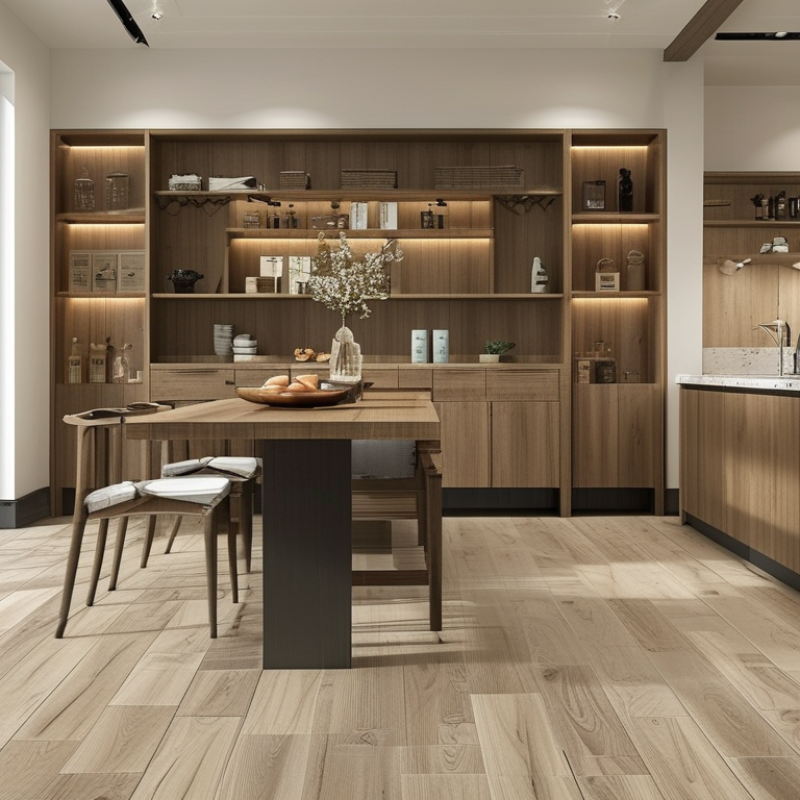
SPC click flooring combines a rigid stone-plastic composite core with a printed décor layer, wear layer, and protective coating. The core usually contains limestone powder, PVC, and stabilizers. It resists indentation better than many softer vinyl products. According to Grand View Research’s 2024 resilient flooring analysis, resilient flooring demand continues to grow because buyers value water resistance, easier maintenance, and faster installation.
Its click system uses a tongue-and-groove profile along the plank edges. One plank angles into the next, then locks when pressed down. Some profiles use a drop-lock edge instead. The joint should close without visible gaps or excessive force. A proper subfloor matters. Dust, moisture, or a 3-millimeter height variation can create movement and joint stress. The National Wood Flooring Association recommends careful subfloor preparation, although SPC installation requirements still depend on the manufacturer’s technical sheet and local conditions.
For Chinese SPC click floors, buyers should verify wear-layer thickness, dimensional stability, locking strength, formaldehyde testing, and third-party quality records. Intertek and SGS reports can support traceability, but a laboratory report is not the same as long-term field performance. The Resilient Floor Covering Institute highlights installation quality as a major factor in flooring durability. That point is easy to underestimate. In practice, one careless click can become a recurring squeak. A thicker wear layer may help busy rooms, yet it cannot correct poor leveling or trapped moisture. Sample testing remains essential, especially when comparing factories, batches, and locking designs.
High-quality SPC click floors from China begin with a stable stone-plastic core. The board should feel dense, resist bending, and retain its shape after temperature changes. Ask for test reports covering dimensional stability, wear resistance, slip performance, and emissions. Documents matter. Samples alone can mislead.
A clean click joint is equally important. Inspect the locking edge for sharp milling, gaps, and crushed corners. During installation, panels should connect with firm pressure, not repeated force. Loose joints often reveal weak geometry or poor calibration. Check several cartons, because one attractive sample cannot prove consistent production. Color, thickness, and edge tolerance should remain uniform across each batch.
The surface also deserves close attention. A durable wear layer should resist scratches from chair legs, grit, and frequent cleaning. Realistic embossing improves grip and reduces the plastic appearance. Water resistance helps, but it does not remove the need for a dry, level subfloor. I have seen excellent panels fail after poor preparation.
Reliable suppliers can provide batch numbers, factory quality records, and independent laboratory reports. Confirm that the reports match the actual product, not an older specification. No floor is flawless. I would still test a full carton before approval, especially in hot, humid, or heavily used rooms. Small defects become expensive when installation has already started.
Comparing Chinese SPC click floor manufacturers requires more than checking price lists. Request production samples from the same collection and inspect them under natural light. Check plank thickness, wear-layer depth, surface texture, dimensional stability, and click-lock accuracy. A strong factory should provide recent test reports from independent laboratories, not only internal claims. Ask about formaldehyde emissions, slip resistance, fire performance, and applicable market requirements. These details reveal technical discipline.
Visit the factory if possible, or arrange a live video inspection. Watch how the manufacturer controls raw materials, mixing, extrusion, printing, and packing. Measure several cartons, because one perfect sample proves little. Review quality records, batch numbering, complaint handling, and replacement procedures. A reliable supplier explains limits honestly. No factory is perfect. I would question any supplier promising zero variation, especially across large orders.
Tips: Compare three suppliers using one written checklist. Check whether the click profile remains tight after repeated assembly. Ask for floor-plan packaging calculations, not rough carton estimates. Confirm lead times during busy seasons. Also, test samples in realistic rooms with changing temperature and humidity. A slightly lower price may hide weaker cores, inconsistent color, or expensive claims later. Good decisions come from evidence, repeated checks, and clear communication.
When comparing SPC click floors from China, buyers should request evidence, not attractive certificates. Grand View Research valued the global luxury vinyl flooring market at about USD 24.45 billion in 2023. However, that figure includes products beyond SPC, so it should not justify every supplier’s claims.
Ask for an ISO 9001 certificate covering the actual factory and production site. Request current test reports from an ISO/IEC 17025-accredited laboratory. Useful checks include dimensional stability, wear resistance, impact strength, locking strength, and residual indentation. ASTM F3261 covers resilient flooring with rigid polymeric cores, while ASTM F2199 evaluates dimensional changes after heat exposure. For European projects, EN 14041 evidence may cover reaction to fire, slip performance, and emissions requirements.
Look closely at the test specimen.
The report should show product thickness, wear layer, batch number, test method, and laboratory identity. Request formaldehyde and VOC results, such as EN 717-1 or recognized indoor-air programs. A recycled-content claim also needs chain-of-custody evidence, not only a supplier declaration. The Freedonia Group identifies resilient flooring as a major growth area, but fast growth can encourage rushed quality control. I have seen cartons pass visual inspection while boards later open at temperature changes. Ask for hot-and-cold cycling, water exposure, and click-joint fatigue tests. One weakness remains: laboratory samples may be selected by the seller, so independent pre-shipment inspection is worth the cost.
Use this buyer checklist when evaluating SPC click-floor suppliers. The suggested evidence count covers product composition, dimensional stability, click-lock performance, surface durability, emissions, and certification validity. Buyers should request test reports from accredited laboratories and verify that the report model, production site, and tested construction match the supplied flooring.
Key references may include EN 16511, ASTM F3261, ISO 10582, ISO 24343-1, ISO 10874, EN 717-1, and applicable local building or chemical-emission regulations. Acceptance limits vary by product construction and destination market.
For homes, choose SPC click flooring with a comfortable underlay, stable locking joints, and a wear layer suited to daily traffic. A 4–5 millimetre board often works well in bedrooms, living rooms, and small apartments. Select natural wood textures for softer rooms. Check the subfloor carefully, because rigid flooring will not hide major bumps.
Retail stores and offices need stronger wear resistance, reliable click connections, and easier maintenance. A thicker commercial wear layer helps manage shopping carts, office chairs, and frequent cleaning. For kitchens, entryways, and bathrooms, SPC offers useful moisture resistance. However, it is not a substitute for proper waterproof installation. Open seams can still cause trouble. I once saw a good-looking floor fail because installers ignored expansion gaps near a glass door.
Tips: Match the wear layer to traffic, not appearance. Request test reports for dimensional stability, slip resistance, fire performance, and emissions. Inspect several cartons before installation. Color variation may be attractive, but damaged edges are not. Ask for installation instructions that fit your climate and subfloor. Chinese SPC click floors can be highly consistent, yet factory quality differs. Review samples, batch records, locking strength, and warranty terms before choosing. A lower price may reflect thinner wear protection or weaker quality control.
Application-based comparison of common Chinese SPC click-floor constructions, using typical market specifications rather than company or brand data.
| SPC Click Floor Type | Best Application | Typical Overall Thickness | Typical Wear Layer | Typical Plank or Tile Size | Water Resistance | Dimensional Stability | Acoustic Performance | Installation Subfloor | Relative Cost | Key Selection Reason |
|---|---|---|---|---|---|---|---|---|---|---|
| Standard Residential SPC Click Floor | Bedrooms, living rooms, dining rooms, and light-use apartments | 3.5–4.5 mm | 0.20–0.30 mm | Approximately 1220–1530 × 180–230 mm | High; suitable for normal household wet-mopping when seams are correctly installed | Good under normal indoor temperature conditions | Moderate; generally improved with an attached underlay | Clean, dry, firm, and level subfloor; uneven areas should be corrected | Low to medium | Balanced entry-level option for everyday residential use |
| Residential SPC with Attached IXPE Underlay | Apartments, upper-floor rooms, home offices, and family living areas | 4.0–5.5 mm, including underlay | 0.30–0.50 mm | Approximately 1220–1530 × 180–230 mm | High; the rigid core and closed-surface wear layer resist routine moisture exposure | Good to very good | Better than bare-back SPC because the attached IXPE layer can reduce impact noise | Firm and level subfloor; avoid installing over soft, unstable, or excessively uneven surfaces | Medium | Convenient installation with improved underfoot comfort and sound reduction |
| Enhanced Residential SPC Click Floor | Busy homes, hallways, kitchens, entryways, and homes with pets | 5.0–5.5 mm | 0.50 mm | Approximately 1220–1830 × 180–230 mm | High; suitable for kitchens and entrances when standing water is promptly removed | Very good | Good, especially when paired with a compatible acoustic underlay | Dry, rigid, and level substrate; moisture testing is recommended for concrete floors | Medium to medium-high | Stronger wear protection and click-joint durability for active households |
| Commercial SPC Click Floor | Retail stores, offices, showrooms, classrooms, and hospitality interiors | 5.0–6.0 mm | 0.50–0.70 mm | Approximately 1220–1830 × 180–305 mm | High; appropriate for routine cleaning, subject to installation-joint limitations | Very good when expansion gaps and room-size limits are correctly followed | Moderate to good, depending on the underlay and floor assembly | Rigid, smooth, dry, and properly prepared commercial subfloor | Medium-high | Higher wear-layer thickness and stronger locking systems support frequent foot traffic |
| Heavy-Traffic SPC Click Floor | Busy retail areas, corridors, reception zones, public interiors, and light commercial facilities | 5.5–6.5 mm | 0.70–1.00 mm | Approximately 1220–1830 × 180–305 mm | High; surface is moisture-resistant, but perimeter and transition detailing remain important | Very good to excellent | Moderate unless an acoustic backing system is specified | Highly level, stable, and clean substrate; installation tolerances should be carefully controlled | High | Best generic choice where abrasion, rolling loads, and long service intervals matter |
| Stone-Look SPC Tile | Kitchens, bathrooms, utility rooms, cafés, and contemporary commercial interiors | 4.0–6.0 mm | 0.30–0.70 mm | Commonly 300–610 × 300–610 mm, or rectangular tile formats | High; appropriate for splash-prone areas when the room and subfloor are properly detailed | Good to very good | Moderate; tile formats may feel firmer underfoot than wider planks | Flat, stable, dry, and properly prepared; avoid direct installation over moving or damaged substrates | Medium to high | Combines a ceramic- or stone-like appearance with faster floating installation |
| Wide-Plank SPC Click Floor | Large living rooms, open-plan interiors, hotels, and visual-design projects | 5.0–6.0 mm | 0.30–0.70 mm | Approximately 1500–1830 × 225–305 mm | High under correct installation and maintenance conditions | Very good, but room-size and expansion requirements must be observed | Good with an appropriate acoustic backing layer | Very flat and stable subfloor; wider boards show substrate irregularities more readily | Medium-high | Provides fewer visible joints and a spacious appearance in larger rooms |
| Herringbone or Chevron SPC Click Floor | Boutique retail, hospitality projects, feature rooms, and decorative residential spaces | 4.0–6.0 mm | 0.30–0.70 mm | Commonly 600–900 × 100–150 mm, depending on the pattern system | High when the locking profile and perimeter detailing are correctly installed | Good to very good | Moderate to good, depending on backing and subfloor construction | Very flat, clean, and stable subfloor; pattern alignment requires careful planning | Medium-high to high | Best for decorative impact, although installation is more labor-intensive than straight planks |
| Fire- and Slip-Performance Specified SPC | Hotels, offices, educational facilities, healthcare support areas, and regulated projects | 5.0–6.0 mm | 0.50–0.70 mm | Approximately 1220–1830 × 180–305 mm | High; verify wet-area limitations and joint protection requirements | Very good | Moderate to good with a tested floor assembly | Prepared subfloor meeting the project specification and moisture requirements | High | Best when documented fire, slip-resistance, and product-testing requirements are central to approval |
Important specification note: Actual performance depends on the complete floor system, including the SPC core, wear layer, printed film, UV coating, click profile, backing, subfloor, room conditions, and installation quality. Before purchase, request current technical data sheets and independent test reports covering abrasion resistance, dimensional stability, slip resistance, fire classification, formaldehyde or VOC emissions, and acoustic performance. Thickness, wear-layer values, sizes, and ratings above are typical market ranges and should not be treated as a certification.


