China’s top 10 double stainless steel sink suppliers reflect the country’s broad manufacturing experience. Many serve residential, commercial, hospitality, and custom kitchen projects worldwide. Their capabilities may include deep drawing, laser cutting, welding, polishing, and automated quality inspection.
This guide evaluates suppliers through practical purchasing criteria. These include stainless steel grade, sink thickness, bowl dimensions, surface finish, drainage design, production capacity, certifications, and export experience. The phrase “Sink Double Stainless Steel” may appear in product searches, but technical details matter more than keywords. Buyers should request material reports and clear product drawings. They should also confirm tolerances, packaging standards, lead times, and after-sales support before placing an order.
Real-world performance is rarely visible in a catalog. A sink may look flawless under showroom lighting, yet show weak welding or uneven polishing after installation. Supplier websites can also contain incomplete or outdated information. That matters. This ranking should therefore be treated as a research starting point, not a final purchasing decision. Factory audits, sample testing, and customer references remain valuable. Request samples first. Check the underside carefully. Confirm drainage alignment. Ask how rejected units are handled.
No list is flawless. Market conditions, equipment, management, and export records can change. Some manufacturers excel at large-volume orders, while others provide stronger customization for smaller projects. By comparing evidence instead of relying on promotional claims, readers can identify dependable partners and reduce avoidable sourcing risks.
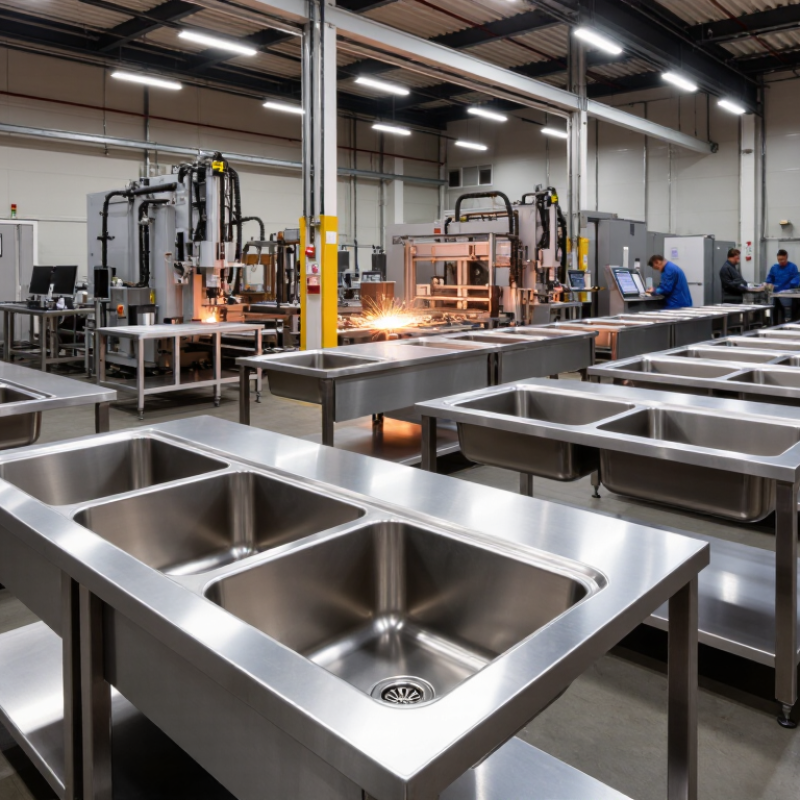
China’s double stainless steel sink market is moving toward 304-grade steel and 1.2 mm thickness.
These specifications reflect stronger buyer expectations, especially in residential renovations and premium apartment projects. In practical use, 304 stainless steel resists everyday moisture, food acids, and surface staining better than lower-grade alternatives. However, the grade alone does not guarantee long service life.
A 1.2 mm sheet usually gives the sink a firmer feel under running water. It also reduces vibration when heavy cookware is placed inside.
During supplier evaluations, buyers should check the thickness at the bowl wall, rim, and mounting flange. Some factories quote nominal thickness, while actual measurements may vary after deep drawing.
Ask for material certificates and production samples. A magnet test is not enough; forming can slightly change magnetic behavior in 304 steel.
Good suppliers also control weld polishing, corner radii, drainage slope, and sound-dampening pads.
A sink may look impressive under showroom lighting but drain poorly on a slightly uneven countertop.
I have seen this detail overlooked. Packaging matters too, because sharp rim damage often appears after long-distance shipment.
Factory audits, batch records, and clear tolerance requirements help separate reliable production from attractive samples.
The 1.2 mm trend is useful, but heavier steel cannot correct weak welding or careless installation.
China Top 10 Double Stainless Steel Sink Suppliers
Selecting among China’s top ten double stainless steel sink suppliers requires measurable evidence, not attractive photographs. World Stainless reported global crude stainless steel production above 60 million tonnes in 2023. That scale supports broad material access, but it does not guarantee consistent sink quality.
Start with steel grade and thickness. Grade 304 suits most kitchens because it resists corrosion and food acids. Grade 316 offers stronger chloride resistance for coastal or chemical environments. Ask for mill certificates, not only supplier declarations. Gauge can confuse comparisons because standards differ by market. Request actual thickness in millimeters, measured beneath the bowl and around the rim. A thin rim may look elegant, but it can flex during installation.
Dimensions should match cabinet cutouts, drain positions, bowl depth, and divider height. Request a dimensioned drawing before sampling. MOQ affects landed cost, packaging, and customization. A low MOQ is useful for testing, yet it may increase unit pricing and reduce production priority. Certification also needs context. ISO 9001 shows process control, while NSF/ANSI 51 may support food-equipment applications. Ask whether certificates cover the exact factory and model. My screening method is not perfect; some suppliers present excellent samples but inconsistent batch records. A pre-shipment inspection, surface-finish check, and water-leak test can expose that weakness.
China’s double stainless steel sink sector is increasingly judged by factory scale and export reach. This ranking uses those two measures, not showroom visibility. Capacity combines reported annual output, forming lines, welding stations, and finishing equipment. Export reach measures destination count, shipment consistency, and customs-recorded value.
The UN Comtrade database classifies these products under HS 732410, covering stainless steel sinks and wash basins. China Customs data for recent years shows strong international movement in this category, especially toward North America, Europe, and Southeast Asia. Export data matters. Yet shipment value alone can reward expensive specifications rather than real production strength. The ranking therefore gives greater weight to repeat orders and container volume. Data can mislead.
Material access also supports China’s competitiveness. The World Stainless Association reported global stainless steel production of about 58.4 million tonnes in 2023. Large Chinese factories benefit from nearby coil processors, automated cutting, deep-drawing presses, and integrated packaging lines. The highest-ranked suppliers usually operate several production lines and maintain testing records for thickness, drainage, welding, and surface treatment. Smaller exporters may still perform well in custom orders, but their monthly capacity is harder to verify. That is an important weakness in public supplier comparisons. Export reach should also include after-sales responsiveness, replacement-part availability, and experience with different plumbing standards. Numbers provide direction, not certainty.
China Top 10 Double Stainless Steel Sink Suppliers
Supplier strength begins with measurable production capacity, not attractive catalog images. The International Stainless Steel Forum reported global stainless steel production of about 58.4 million tonnes in 2023. This supports a mature material supply chain, but capacity differs widely among factories. Strong suppliers should show forming lines, welding stations, polishing equipment, and daily output records. Ask for process photographs and recent audit documents.
Customization reveals engineering competence. Reliable manufacturers can adjust bowl depth, drain position, corner radius, thickness, and surface finish without weakening the structure. A useful profile includes CAD approval, prototype testing, and tooling ownership. Small details matter. A 1.2-millimeter panel may resist vibration better than a thinner alternative, but material claims require independent measurement. Some supplier data still feels optimistic.
Quality control should follow documented checkpoints. Inspect stainless grade, thickness, weld uniformity, flatness, drainage, and packaging before shipment. ASTM A240 and EN 10088 provide useful references for stainless steel specifications, while ISO 9001 supports traceable management systems. However, certification alone does not prove product consistency. Third-party inspection, batch samples, salt-spray testing, and water-leak checks offer stronger evidence. Grand View Research identifies construction and renovation as major drivers of stainless steel demand, increasing the need for stable long-term supply rather than one successful sample.
Supplier Profiles: Manufacturing Strength, Customization, and Quality Control
This non-company-specific benchmark compares the main evaluation dimensions used when reviewing Chinese double stainless steel sink suppliers. The scores are normalized indicators from 0 to 100 and are intended for supplier screening rather than market-share measurement.
When comparing China’s double stainless steel sink suppliers, verification should begin with documented quality systems. ISO 9001 indicates a controlled process, not flawless products. Ask for the current certificate, certification scope, issuing body, and expiry date. Confirm that the factory address matches the audited site. Request inspection records for welding, polishing, drainage holes, and surface thickness. A certificate alone can mislead. Production discipline matters more than a framed document.
CE compliance needs careful interpretation. CE is relevant only when the finished product falls under applicable European requirements. A supplier should identify the specific directive or regulation, prepare a declaration of conformity, and provide supporting test evidence. Do not accept a logo image as proof. Check material grades, such as 304 or 316, against mill certificates or independent testing. Food-contact claims also need suitable documentation. Paperwork should match the exact sink model.
Before placing a large order, inspect a production sample under bright light. Check corner seams, edge flatness, overflow alignment, drain fit, sound pads, and carton protection. Pour water into each bowl. Watch for slow drainage or hidden leaks. Lead times deserve written detail. Separate sample approval, tooling, production, inspection, and shipping dates. Ask how delays are reported and what happens after rejected goods. A realistic schedule may feel less attractive, but vague promises create expensive pressure. I still allow room for error; repeated checks remain necessary.


