Choosing a Refrigeration Fan Motor in 2026 requires more than matching voltage and horsepower. The correct decision begins inside the cabinet, beside the evaporator coil, where frost, moisture, vibration, and limited airflow affect every operating hour. A motor that looks suitable on paper may overheat when the condenser room reaches 40°C. Small details matter.
“Motor selection must follow the application, not the catalogue,” says Dr. James R. Kauffman, a refrigeration systems engineer and technical educator. His point remains practical. Check the fan blade diameter, rotation direction, mounting pattern, shaft size, duty cycle, and actual load. Confirm whether the motor supports variable-speed control, electronic commutation, or simple fixed-speed operation. Energy efficiency also matters, but efficiency alone cannot rescue an incorrectly sized motor.
Start with the operating environment. Is the unit exposed to washdown water, salt air, oil mist, or frequent defrost cycles? Look for the correct ingress protection rating and insulation class. Listen for bearing noise. Feel the housing temperature after a stable run. These observations can reveal problems that a specification sheet misses.
Be careful with assumptions. A larger motor is not automatically safer. It may draw unnecessary power, disturb airflow, or increase noise. I have seen replacements fail because technicians copied the old label without checking the fan blade pitch. That shortcut seemed reasonable. It was not.
This guide explains how to compare motor technology, electrical compatibility, environmental protection, controls, service life, and total operating cost. The goal is simple: choose a Refrigeration Fan Motor that performs reliably in real conditions, not merely inside a product table.
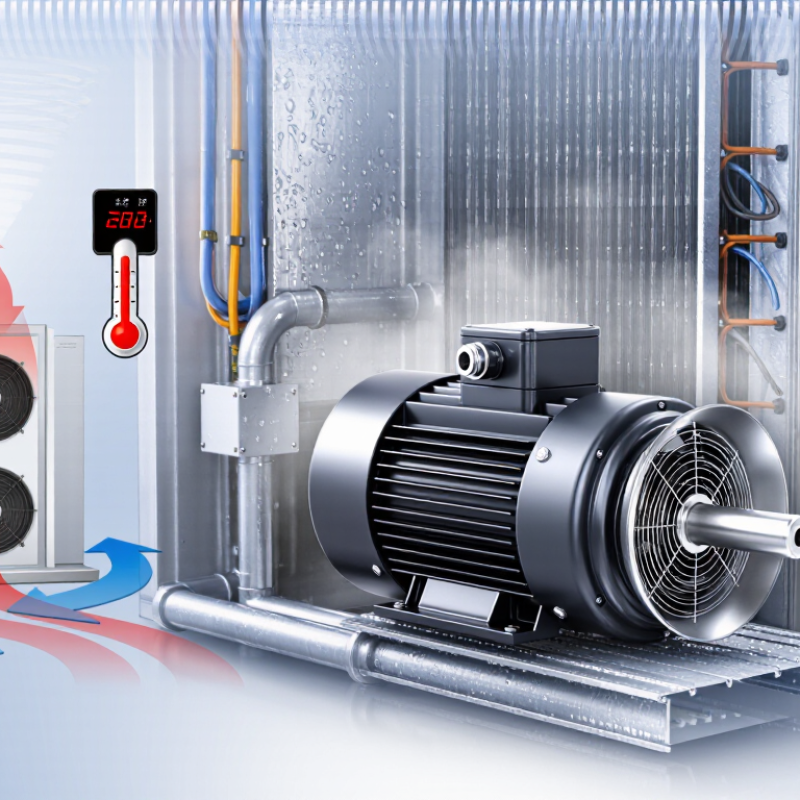
Choosing a refrigeration fan motor in 2026 starts with measured cooling requirements, not a catalog size. Record the cabinet temperature, ambient temperature, coil dimensions, and product load. Then define the required airflow in cubic feet per minute or cubic meters per hour. More airflow is not always better. Excessive velocity can dry products, increase noise, and disturb temperature stability.
Static pressure deserves equal attention. Filters, guards, narrow coil passages, and frost buildup can sharply reduce delivered airflow. I usually test the system at its real operating pressure, rather than trusting free-air ratings. A motor delivering 1,200 m³/h without resistance may provide far less through a loaded evaporator. Check the fan curve, pressure point, operating voltage, and speed range together. Small details matter.
Use 2026 duty data to describe how the motor will actually work. Include daily run hours, defrost intervals, start-stop frequency, seasonal ambient peaks, and expected speed changes. Variable-speed operation may reduce energy use, but repeated acceleration can increase thermal stress.
I once selected a motor from average temperature data and underestimated summer cycling. The result was acceptable, but not comfortable. A better review uses logged temperature and current readings for several weeks. Leave practical margin, yet avoid oversized motors that create heat, vibration, and unnecessary power demand. Wet conditions also require suitable insulation and dependable protection.
Motor technology should match the cabinet, not just the purchase price. The IEA’s Energy Efficiency 2023 report states that electric motor systems use roughly half of global electricity. Small fan motors matter when they run continuously. EC motors usually deliver the highest efficiency, often above 70%, while adding electronic commutation and speed control. They suit condenser and evaporator fans with changing heat loads. However, electronics may require better protection from moisture, heat, and voltage disturbances.
PSC motors offer a familiar, moderate-cost solution. Their efficiency commonly falls around 45% to 65%, depending on size and operating point. They work well at steady speeds, but their capacitor creates losses and their speed control is limited.
Shaded-pole motors are simple and inexpensive. They can be reliable in small, low-pressure fans, yet efficiency may remain near 20% to 35%. Extra heat becomes noticeable inside a warm refrigeration compartment. The U.S. Department of Energy’s motor-system assessments repeatedly identify part-load operation and poor matching as major sources of wasted energy.
A practical selection starts with annual operating hours, airflow, static pressure, ambient temperature, and defrost conditions. EC is not automatically best. A poorly protected EC controller can fail before a basic PSC motor. Conversely, choosing shaded-pole technology for a 24-hour fan may create years of avoidable electricity cost. Check measured efficiency at the actual duty point, not only the catalog maximum. My early preference was always EC, but lifecycle calculations sometimes challenge that assumption. Installation quality still matters.
How to Choose a Refrigeration Fan Motor in 2026?
Electrical compatibility must be verified before comparing efficiency or price. Read the original nameplate carefully. Confirm 115 or 230 V, 50 or 60 Hz, single or three phase, and rated RPM. A 115 V motor connected to 230 V can fail quickly. A dual-voltage motor still needs the correct lead configuration. Do not trust wire colors alone. Check the wiring diagram and measure supply voltage at the motor terminals under load. The U.S. Department of Energy’s Commercial Refrigeration Equipment Technical Support Document evaluates equipment under defined electrical conditions, showing why field performance depends on correct operating inputs.
Frequency changes speed. A motor designed for 60 Hz may run noticeably slower on 50 Hz, even when voltage seems correct. For a four-pole motor, synchronous speed is about 1,800 RPM at 60 Hz and 1,500 RPM at 50 Hz, before slip. That difference can reduce airflow and raise cabinet temperature. ASHRAE Handbook—Refrigeration emphasizes airflow, heat transfer, and equipment operating conditions when assessing refrigeration performance. Match the replacement motor’s RPM, rotation, fan blade load, and capacitor requirements. Check phase carefully; a single-phase replacement is not equivalent to a three-phase model.
Small errors become expensive. I have seen technicians match voltage but overlook frequency. That choice looked acceptable on paper. It was not. Record the measured voltage, frequency, phase, and RPM before ordering. If the nameplate is damaged, pause and confirm the equipment documentation. Guessing is cheaper only until the first service call.
The chart shows theoretical synchronous speed calculated with the formula RPM = 120 × frequency ÷ pole count. Actual induction-motor speed is normally slightly lower because of slip, so use the motor nameplate RPM for final fan and refrigeration-system compatibility.
When choosing a refrigeration fan motor in 2026, reliability starts with its protection details. A motor may look powerful, yet fail after months of condensation, dust, and repeated starts. I inspect the enclosure rating before comparing airflow or price. IP55 helps limit dust entry and protects against low-pressure water jets. It does not make the motor waterproof. Do not guess.
Class F insulation is another practical checkpoint. It tolerates winding temperatures up to 155°C under its insulation system rating, providing useful thermal margin in demanding rooms. However, insulation class alone cannot prevent overheating. Ask for thermal protection, such as an embedded protector or compatible external control. Confirm its trip behavior, reset method, and wiring instructions. Small details matter. A motor that restarts automatically may create a maintenance hazard if the fault remains.
During equipment checks, I also verify rated voltage, frequency, current, bearing noise, and operating position. Look for test records, temperature-rise data, and clear installation guidance from the supplier. Check the sample after continuous operation, not only at startup. Moisture around terminals is easy to overlook. A checklist is useful, but it is not perfect; site conditions can expose weaknesses that laboratory tests miss. Record ambient temperature and defrost cycles during evaluation, especially when the room shifts between cold storage and warm cleaning.
When selecting a refrigeration fan motor, calculate its lifetime cost across 8,760 operating hours. Start with measured input power, not only the nameplate rating.
A motor drawing 0.12 kilowatts uses 1,051.2 kilowatt-hours yearly. At $0.15 per kilowatt-hour, annual electricity costs about $158. Small differences become expensive over several years. They add up.
Compare motors under the same airflow and pressure conditions. A lower-wattage model may save energy, but only if it maintains stable cabinet temperatures. Check operating temperature, speed control, bearing design, protection rating, and expected service life. Ask for tested efficiency data. Do not rely on attractive estimates. In real installations, blocked grilles, dust, and voltage variation can increase consumption.
My first calculation was too optimistic because I used rated power instead of measured power. A plug-in wattmeter revealed higher demand during hot afternoons. Measure the motor during normal and peak conditions, then multiply average kilowatts by 8,760 hours.
Add purchase price, installation labor, cleaning, and likely replacement costs. A motor costing slightly more may be the safer choice if it reduces heat, noise, and emergency maintenance. Still, predictions remain imperfect. Review actual energy bills after installation and adjust the next selection.


