Buying a Firefighting Drone is not simply a matter of choosing the longest flight time or the largest camera. Global buyers must connect equipment with real fireground conditions. A high-rise rescue, a forest fire, and an industrial warehouse demand different capabilities. Heat resistance, thermal imaging, water exposure, signal stability, battery endurance, and payload design can change operational results.
Charles Werner, founder of DRONERESPONDERS and a respected public-safety technology expert, has repeatedly emphasized this principle: “Drones are not replacing firefighters; they are enhancing firefighter safety.” That idea should guide every purchasing decision. A drone may scan a burning roof, locate hidden heat, or inspect a damaged structure before crews enter. It cannot replace command judgment, trained pilots, or disciplined emergency procedures.
This guide presents seven practical Firefighting Drone buying tips for global buyers. It examines thermal camera quality, flight performance, communications, maintenance support, software, training, and total ownership cost. Each factor matters. A clear image is useless if the connection drops behind concrete walls. A powerful aircraft is impractical if replacement batteries take weeks to arrive. A low purchase price may conceal expensive repairs, limited technical support, or difficult operator training.
No checklist is perfect. Conditions change quickly.
Buyers should also question optimistic supplier claims and request field evidence. Ask for test footage, environmental ratings, service timelines, and realistic battery data. The right choice is not always the most advanced model. It is the system that firefighters can deploy confidently, maintain consistently, and trust when visibility disappears.
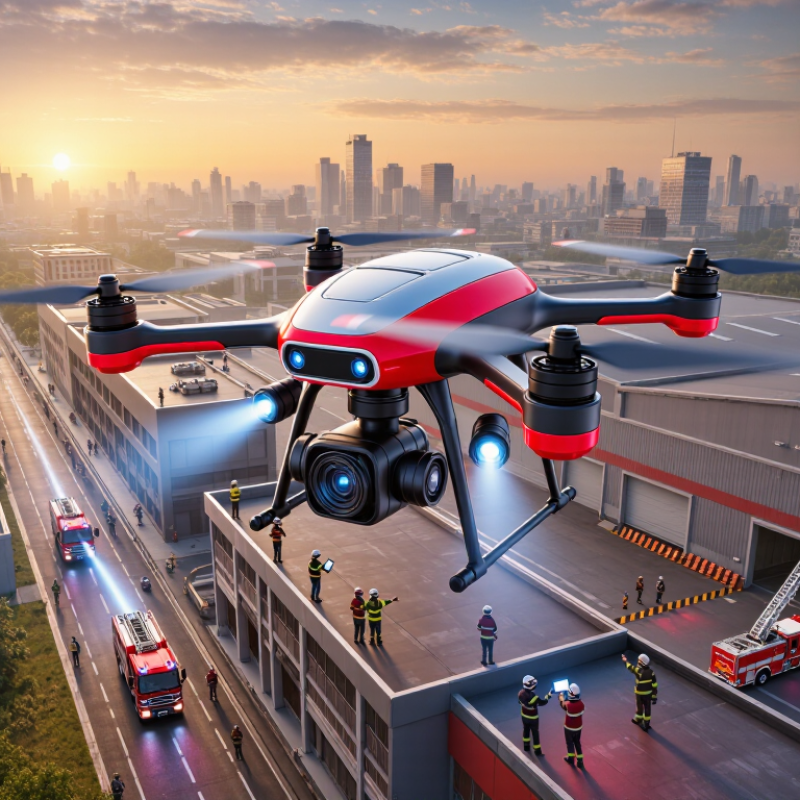
A firefighting drone should solve a defined emergency problem, not merely look advanced. NFPA’s Fire Loss in the United States During 2023 estimated 1,388,500 fires nationwide. Your mission may involve roof inspections, wildfire mapping, search support, or thermal hotspot detection. Each task requires different sensors, endurance, payload capacity, and flight range.
Write the operating scenario before comparing aircraft. Specify launch locations, building heights, smoke density, wind, rain, and night operations. A compact drone may work well in narrow streets. It may fail above a large industrial site. A specification sheet can still mislead. Treat advertised flight time as optimistic, especially with strong winds or heavy sensors.
Define the minimum useful performance. For example, require a thermal camera that identifies heat variation at your working distance, not only a high-resolution daylight camera. NIST research on public safety communications highlights the importance of reliable data links in complex environments. Test video transmission behind concrete walls, near electrical equipment, and around hills. Also measure setup time, battery changes, pilot training, and recovery procedures. These details often decide whether crews gain information quickly or wait beside the fire. Review local aviation, radio-frequency, privacy, and emergency-operation requirements before deployment.
Firefighting drones should be compared by mission performance, not advertised flight time.
NFPA’s Fire Loss in the United States During 2022 recorded about 1.5 million fires, showing why rapid aerial assessment matters.
Tip 1: Check hover endurance with the full payload attached.
Tip 2: Demand thermal imaging that identifies heat through smoke, not only standard video.
Tip 3: Compare wind resistance, night operation, and battery replacement time.
A drone that lands every eight minutes is not operationally efficient.
Payload design directly affects suppression results.
Tip 4: Measure water or agent capacity, discharge rate, nozzle range, and spray pattern together.
A large tank can still perform poorly with weak pressure.
Tip 5: Review the aircraft’s maximum takeoff weight, because extra cameras and hoses reduce endurance.
Industry testing should include heat, wind, dust, and uneven terrain. Laboratory results alone can mislead buyers.
Tip 6: Ask for independent test records, maintenance intervals, and operator training requirements.
Tip 7: Confirm compatibility with approved extinguishing agents and local aviation procedures.
The NFPA report also recorded 3,790 civilian fire deaths in 2022, reinforcing the need for dependable communication and accurate mapping.
My field experience suggests one weakness remains common: buyers compare payload volume but overlook refill logistics.
A practical trial should measure time from launch to detection, discharge, refill, and redeployment.
When global buyers assess a firefighting drone, flight safety deserves more than a specification sheet. Ask for independent test records covering motor failure, battery overheating, signal loss, and emergency landing. A dual-power design can preserve control, but it cannot remove every risk. Check geofencing, obstacle sensing, return-to-home behavior, and propeller guards. Test these functions with trained operators, not only in a showroom. Small details matter. Confirm the aircraft remains stable while carrying water or thermal equipment. Payload changes handling quickly.
Control quality becomes critical near smoke, steel structures, and strong radio interference. Look for encrypted command links, clear alerts, manual override, and a control range measured in real conditions. Request drill logs showing latency, wind speed, and recovery time. A simple interface helps new crews, yet automation can create false confidence. Operators still need recurrent training and a written failure procedure. I would not accept marketing claims without raw flight data and maintenance records. That standard may slow purchasing, but it protects crews and public property.
Environmental capability should match the actual incident area. Review wind tolerance, operating temperature, rain resistance, dust protection, and night visibility. Salt air near ports can damage connectors faster than expected. Mud can block cooling paths. Ask how sensors perform through smoke, glare, and changing heat signatures. Measure battery endurance with the full payload, not an empty aircraft. Independent field trials are valuable, although one trial cannot represent every climate. Leave room for doubt. A reliable supplier should explain limitations, spare parts, software updates, and inspection intervals in clear documents.
7 Firefighting Drone Buying Tips for Global Buyers
Tip 1: Check local regulations before comparing flight range or thermal cameras. Firefighting drones may require aviation approval, radio-frequency clearance, pilot registration, or operational permits. Rules differ between countries and sometimes between provinces. Ask the supplier for current compliance documents, but verify them with your aviation authority. A sales sheet is not legal proof.
Tip 2: Review certifications carefully. Check battery transport documents, electrical safety reports, ingress protection ratings, and radio compliance. Certifications should match the exact drone, battery, charger, and software version. Look for testing laboratories with recognized accreditation. Small details matter. An outdated certificate can delay deployment or create insurance problems. I would also request serial-number traceability, although buyers sometimes overlook it during urgent procurement.
Tip 3: Treat training and technical support as operating requirements, not optional extras. Operators should practice thermal imaging, smoke-obscured navigation, night procedures, emergency landing, and battery handling. Ask whether training includes realistic drills near buildings, vehicles, and uneven ground. Support should cover spare parts, firmware guidance, remote diagnostics, and response times across time zones. Confirm who repairs damaged airframes and how long replacement batteries take. A weak support plan may look acceptable on paper, then fail during a difficult callout. That risk deserves written service terms.
| No. | Buying Dimension | What Global Buyers Should Check | Practical Requirements and Reference Points | Why It Matters |
|---|---|---|---|---|
| 1 | Regulatory Approval and Airspace Access | Confirm the aircraft category, operating limits, pilot requirements, remote-identification rules, registration duties, and permissions for flights near people, airports, emergency scenes, or controlled airspace. | Required before operation Obtain written guidance from the aviation authority in the country of operation. Rules differ by jurisdiction, especially for beyond-visual-line-of-sight flights, night operations, high-risk areas, and flights over populated locations. | A technically capable drone may still be prohibited from a planned mission. Unauthorized flights can cause enforcement action, mission delays, insurance problems, or interference with emergency aviation. |
| 2 | Conformity, Safety, and Product Documentation | Review the declaration of conformity, applicable radio and electrical safety documentation, battery transport documents, user manuals, maintenance instructions, and serial-number traceability. | Verify for the destination market Ask for test reports or conformity documents applicable to the destination country or region. Confirm that the aircraft, controller, radio equipment, charger, and batteries are covered—not only the airframe. | Missing documentation can prevent import, customs clearance, insurance approval, or legal deployment. Incomplete manuals also increase the chance of unsafe maintenance and incorrect emergency procedures. |
| 3 | Firefighting Payload and Mission Performance | Compare useful payload, water or suppressant capacity, release method, refill time, hover endurance, wind tolerance, operating temperature, obstacle avoidance, thermal imaging, and visibility in smoke or darkness. | Test with an operational scenario Request independent or witnessed test data showing payload, flight time, maximum wind conditions, thermal-camera performance, communication range, and repeatable release accuracy. Distinguish maximum take-off weight from usable payload. | Published maximum figures may not represent real firefighting performance. Payload, heat, wind, altitude, battery temperature, and repeated water drops can significantly reduce endurance and stability. |
| 4 | Communications and Operational Resilience | Evaluate command-link range, frequency authorization, encryption, latency, network dependence, return-to-home behavior, lost-link settings, navigation redundancy, and operation in smoke, urban canyons, forests, or mountainous terrain. | Recommended acceptance test Conduct a site survey and a supervised field test. Confirm whether the system supports local control without public cellular coverage and whether geofencing, mapping, and firmware functions work in the intended country. | Signal loss, electromagnetic interference, or unavailable network services can cause a lost aircraft, an uncontrolled landing, or the loss of live situational awareness during a time-critical incident. |
| 5 | Pilot, Crew, and Fire-Service Training | Assess training for flight operations, payload use, thermal-camera interpretation, emergency procedures, battery handling, airspace coordination, incident command, data protection, and post-flight inspection. | Include in the purchase plan Require a documented syllabus, instructor qualifications, practical flight assessment, recurrent training schedule, and scenario exercises for lost link, low battery, high wind, communications failure, and crewed-aircraft conflict. | A certified aircraft does not automatically mean that the crew is qualified to operate it. Poor coordination can endanger firefighters, pilots, bystanders, and other emergency responders. |
| 6 | Technical Support, Spare Parts, and Maintenance | Confirm local response coverage, repair capability, software-update policy, spare-motor and propeller availability, battery replacement procedures, calibration support, warranty terms, and expected service life. | Define in the contract Set measurable response times, escalation contacts, repair turnaround targets, preventive-maintenance intervals, battery health limits, inspection checklists, and availability of critical parts for the expected operating period. | Emergency fleets cannot rely on long overseas repair cycles. Delays in batteries, pumps, controllers, sensors, or firmware support can make the system unavailable when incidents occur. |
| 7 | Total Cost, Data Governance, and Procurement Fit | Calculate the full lifecycle cost, including aircraft, payload modules, batteries, chargers, transport cases, training, permits, insurance, connectivity, software, maintenance, replacement parts, and secure data storage. | Compare lifecycle cost, not only purchase price Confirm data ownership, cloud-storage location, access controls, retention periods, export capability, cybersecurity responsibilities, and compatibility with the fire service’s command-and-control systems. | The lowest purchase price may create higher operating costs or data risks. Unclear ownership and storage arrangements can affect public-sector procurement, privacy compliance, evidence handling, and long-term system integration. |
A low purchase price can hide expensive operating demands. Calculate the aircraft, thermal camera, payload system, batteries, chargers, software, training, shipping, taxes, and storage. Include spare propellers, motors, seals, and landing gear. These small parts often decide whether a drone flies during a real emergency.
Estimate battery replacement cycles from actual mission patterns. A drone flying near smoke, heat, saltwater, or dust may need more frequent inspection. Add technician hours, calibration, insurance, and annual testing to your budget. Do not ignore downtime. One unavailable aircraft can delay a search across a warehouse roof. It sounds obvious. It is often missed.
Supplier reliability needs evidence, not polished promises. Request documented flight tests, thermal-camera samples, maintenance schedules, and response times for technical support. Ask where replacement parts are stored and how quickly they can reach your region. Check whether training includes night operations, confined areas, wind limits, and payload handling. A clear warranty matters, but service after the warranty matters more. Some buyers focus too heavily on specifications and overlook local repair capability. That is a costly mistake. Require realistic delivery dates, transparent payment terms, and written responsibilities for software updates. Test communication before ordering. A supplier that answers slowly during evaluation may respond even slower during an urgent repair.


