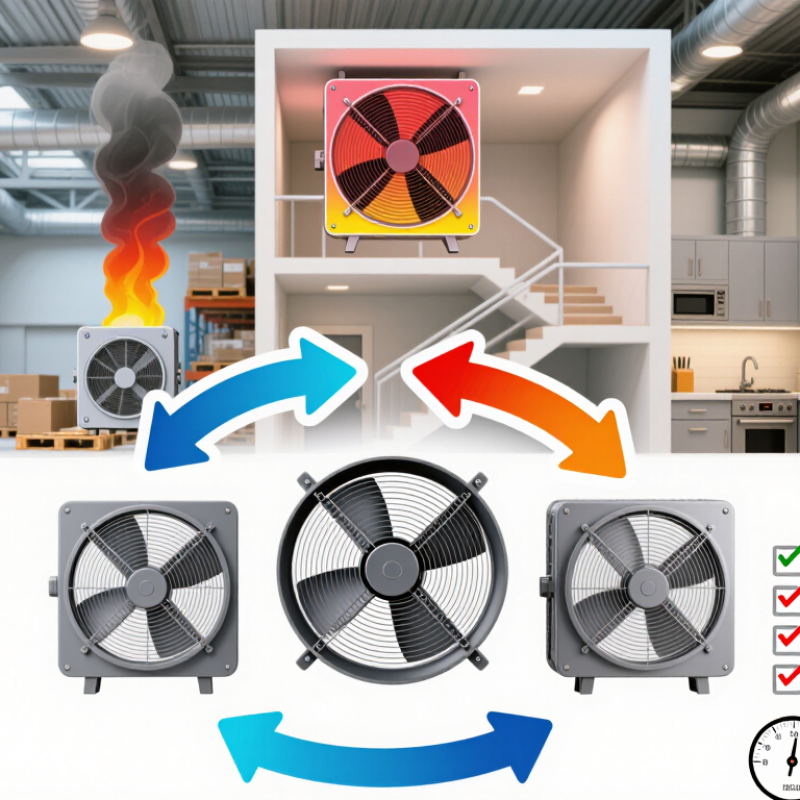
Choosing a Fire-Resistant Fan requires more than checking a product label. In a hot, smoky room, airflow may determine whether people can escape safely. The right unit must match the building’s hazard, temperature, pressure, and ventilation design. A warehouse fan faces different demands from a kitchen exhaust fan. Experience matters here. I have seen specifications look impressive while the actual duty point was overlooked. That mistake can cause weak extraction, excessive noise, or premature failure. A careful selection begins with the application, not the catalogue photograph.
Reliable decisions use tested performance data and recognized certification. Check operating temperature, fire exposure duration, airflow, static pressure, motor placement, and electrical protection. Do not treat “fire-rated” as a universal promise. It may describe one component, not the complete installed system. Ask for test reports, installation limits, maintenance instructions, and traceable manufacturer information. An independent fire engineer or ventilation specialist should review critical applications. Local codes and project approvals also matter. Details matter.
During evaluation, imagine the fan above a stairwell, with hot air rising and access becoming difficult. Can it maintain its rated performance? Can technicians inspect belts, bearings, wiring, and dampers without unsafe delays? Consider standby power, control signals, corrosion, and emergency testing. A robust Fire-Resistant Fan still needs correct ductwork, secure mounting, and scheduled maintenance. Selection is not perfect science. Data can be incomplete, and site conditions may change. Record assumptions clearly, challenge optimistic claims, and confirm every critical value before installation. Safety deserves evidence, not guesswork.
Choosing a fire-resistant fan begins with the fire, not the catalog. In a plant survey, I look for the likely fuel, ignition source, smoke path, and exposure time. Is the fan serving a commercial kitchen, battery room, furnace area, or smoke-control system? Grease, dust, solvents, and hot gases create different hazards. A fan near a furnace may face radiant heat, while a smoke-extraction fan must keep operating during evacuation. “Fire resistant” is not one universal condition. Ask for the tested temperature and operating duration.
Define the performance target in measurable terms. Record required airflow, static pressure, duct length, damper resistance, and ambient temperature. Include system leakage and dirty-filter conditions; these details often reduce real airflow. Confirm whether the fan must run continuously, start during an alarm, or support emergency extraction. Check motor cooling, shaft seals, bearings, and wiring insulation. A remote motor can reduce heat exposure, but it does not solve every fire scenario. Pressure readings matter.
Request test reports, installation limits, maintenance instructions, and certification accepted by the local authority. The fan should match the complete assembly, including ducts, supports, dampers, and controls. Inspect access panels and clearances before purchase. I have seen strong equipment underperform because a damper stuck or a cable overheated. That mistake is easy to miss. Review the design with a fire engineer and ventilation contractor. Recheck assumptions after commissioning, especially airflow at operating temperature.
Choosing a fire-resistant fan requires more than reading the product label. Check its certification documents first. A credible certificate should identify the tested model, test method, temperature exposure, operating time, and installation limits. Verify the document with the testing laboratory when possible. Similar-looking certificates may cover different configurations.
Look closely at the materials. A steel or aluminum housing can resist heat, but seals, wiring insulation, bearings, and cable glands may fail earlier. The impeller must remain balanced after thermal exposure. Ask whether the fan uses heat-resistant insulation and protected bearings. Small parts matter.
Temperature ratings need careful reading. Some ratings describe normal operation, while others describe emergency smoke extraction. Do not treat them as interchangeable. For example, a fan rated for 300°C over 60 minutes may not suit a 600°C exposure for 120 minutes. Confirm airflow at the stated temperature, not only at room conditions. Installation position also affects performance.
A site inspection can reveal practical problems. Dust buildup, loose wiring, or blocked inlets may reduce safety margins. Maintenance records should match the certified configuration. In practice, specifications are sometimes misunderstood, and that deserves honest review. Ask a qualified fire engineer to compare the certificate, drawings, and actual installation before approval.
Choosing a fire resistant fan starts with airflow, not the catalogue size. Determine the required air volume in cubic feet per minute, then calculate system pressure at the actual duct layout. Elbows, dampers, filters, and vertical shafts can increase resistance sharply.
NFPA’s Fire Loss in the United States During 2022 reported about 1.5 million fire incidents, showing why reliable smoke movement deserves careful design. NFPA 92 also requires smoke-control systems to maintain their intended performance under defined fire conditions.
Size must fit the duty point, access space, and maintenance plan. A fan operating far from its tested curve may deliver less airflow and consume more power.
AMCA 210 provides standardized airflow and pressure testing, while EN 12101-3 addresses powered smoke and heat exhaust fans.
Check the temperature-time rating, casing materials, bearings, and motor cooling method. Drive selection matters too. Direct drive reduces belt maintenance, but a belt drive can offer adjustment and easier motor replacement. Variable-frequency drives need suitable fire-mode controls and bypass arrangements.
Keep the motor outside the hot airstream when the design permits. That detail can protect the drive during a smoke event.
A neat selection can still be wrong. I would recheck pressure losses after installation, because field routing rarely matches the first drawing.
Test the final system under realistic airflow, pressure, and emergency-control conditions.
Choosing a fire-resistant fan starts with the installation environment, not the product label. Measure the duct route, room temperature, airflow demand, and available power. Check whether the fan serves smoke extraction, process exhaust, or emergency ventilation. Each duty requires different temperature ratings and operating times. I would also verify local fire codes and obtain documentation from a qualified engineer. A fan can look robust yet fail when exposed to heat, pressure, or contaminated air.
Safety features deserve close inspection. Look for tested thermal performance, secure electrical insulation, suitable casing materials, and reliable overload protection. Confirm that the control system can respond during power failure or emergency activation. Keep combustible storage away from access panels and motor areas. Small clearances matter. During a site review, I would photograph cable routes and label isolation switches clearly. One overlooked cable may delay maintenance or create unnecessary risk.
Maintenance access is often underestimated. Leave enough space to remove filters, inspect bearings, tighten connections, and test sensors without dismantling nearby equipment. Use inspection doors where ducts are long or difficult to reach. Record vibration, noise, temperature, and airflow during routine checks. A sudden change can reveal wear before failure occurs. I once treated easy access as a design detail, but it affected service time more than expected. Recheck the layout after installation. Real buildings rarely match the drawing.
| Evaluation Dimension | Installation Condition or Requirement | Recommended Selection Criteria | Relevant Safety or Performance Check | Maintenance Access Consideration |
|---|---|---|---|---|
| Airflow and system resistance | The fan must overcome the total pressure loss of ducts, filters, dampers, grilles, and other components. | Select a fan from a certified performance curve at the design airflow and required static pressure, rather than selecting by motor power alone. | Verify airflow, static pressure, operating point, system effect, and adequate margin against unexpected resistance. | Provide access for inspection and cleaning of the impeller, casing, filters, and connected ductwork. |
| Fire or smoke duty | The fan may be required to operate during a fire, for smoke extraction, stairwell pressurization, car-park ventilation, or emergency exhaust. | Choose equipment tested and certified for the specific smoke-control duty, temperature, and operating duration required by the project. | Check the applicable local building code and the declared fire-resistance classification, such as a stated temperature and duration rating. | Ensure emergency components can be inspected without disabling unrelated life-safety systems. |
| Ambient temperature | The installation may be exposed to normal operating heat, seasonal outdoor temperatures, or elevated fire conditions. | Confirm the permitted ambient temperature range for the fan, motor, bearings, seals, controls, and electrical components. | Do not confuse a short-duration fire rating with continuous operation at elevated temperature; verify both ratings separately. | Locate temperature-sensitive controls where they remain within their rated range and can be replaced safely. |
| Hazardous or explosive atmosphere | The air may contain flammable gases, vapors, mists, or combustible dust. | Use a fan and motor configuration suitable for the classified hazardous area, with compatible materials and certified electrical equipment. | Confirm the zone or division classification, gas or dust group, temperature class, equipment protection level, and certification requirements. | Use controlled maintenance procedures to prevent ignition sources, static discharge, incorrect replacement parts, or unsafe opening of equipment. |
| Corrosive, wet, or contaminated air | The fan may handle moisture, salt-laden air, chemical vapors, grease, dust, or process contaminants. | Specify suitable casing, impeller, fasteners, coatings, seals, drainage, and ingress protection for the environment. | Check material compatibility, corrosion resistance, condensation control, and the enclosure rating of electrical components. | Allow space to remove deposits, drain moisture, inspect corrosion, lubricate bearings where applicable, and replace damaged protective coatings. |
| Electrical supply and controls | The available supply may be single-phase or three-phase, with specific voltage, frequency, starting-current, and emergency-power requirements. | Match the motor and control equipment to the electrical supply and verify compatibility with starters, variable-speed drives, alarms, and backup power. | Provide overload protection, short-circuit protection, correct earthing, emergency isolation, and any required fail-safe control logic. | Position isolators and control panels for safe access, clear labeling, testing, and lockout/tagout procedures. |
| Non-sparking construction | The fan may handle flammable atmospheres or require reduced risk of mechanical spark generation. | Consider an appropriate impeller and casing material combination, adequate clearances, and protection against rubbing or foreign-object impact. | Verify the construction method against the applicable hazardous-area or non-sparking requirements; inspect clearances regularly. | Provide removable panels or inspection ports so that impeller balance, clearances, and buildup can be checked without major dismantling. |
| Noise and vibration | The fan may be installed near occupied areas, sensitive equipment, or structural elements that transmit vibration. | Review sound power data, fan speed, balancing quality, flexible connections, inertia bases, and vibration isolators. | Establish acceptable vibration and noise limits for the site and monitor changes that may indicate imbalance, bearing wear, or looseness. | Keep vibration measurement points, bearings, fasteners, and isolators accessible for routine inspection. |
| Installation location | The fan may be roof-mounted, indoors, outdoors, in a plant room, in a service shaft, or within a restricted-access area. | Select a configuration suitable for weather exposure, lifting requirements, structural loads, orientation, drainage, and available clearances. | Confirm structural support, anchorage, weather protection, fall protection, safe electrical isolation, and compliant access routes. | Reserve sufficient working space for panel removal, motor access, impeller extraction, belt replacement, and safe technician movement. |
| Maintenance access | Routine servicing may be required in a confined plant room, ceiling void, shaft, roof area, or hazardous location. | Prefer designs with accessible inspection doors, removable guards, replaceable bearings, and clearly defined service clearances. | Check that maintenance can be performed with the equipment isolated, depressurized, cooled, and made safe from fire or explosion hazards. | Document isolation points, inspection intervals, lubrication requirements, belt tension checks, cleaning procedures, and replacement-part specifications. |
| Dampers and system interfaces | The fan may connect to fire dampers, smoke dampers, backdraft dampers, filters, silencers, or other air-handling components. | Confirm that connected components are compatible with the airflow direction, pressure, temperature, fire strategy, and control sequence. | Verify correct damper position feedback, interlocks, access for testing, and prevention of unintended recirculation or backflow. | Ensure each interface can be inspected and tested without removing large sections of ductwork. |
| Documentation and certification | The project may require evidence of performance, fire testing, hazardous-area compliance, electrical conformity, and installation instructions. | Select equipment supported by current test reports, certificates, drawings, wiring diagrams, performance data, and maintenance instructions. | Check that certificates apply to the exact configuration, including motor, controls, materials, temperature rating, and intended installation. | Keep service records, inspection results, test certificates, modifications, and replacement-part information available throughout the equipment life. |
| Commissioning and periodic testing | The fan must start reliably, deliver the required airflow, and respond correctly to normal and emergency signals. | Require documented commissioning, functional testing, airflow verification, alarm checks, rotation checks, and emergency operating tests. | Test automatic start, manual override, power-failure response, interlocks, damper operation, alarm reporting, and standby arrangements where provided. | Create a scheduled inspection plan based on operating hours, contamination level, criticality, statutory requirements, and manufacturer instructions. |
Selection note: The final specification should be reviewed against the project fire strategy, local building and electrical codes, hazardous-area classification where applicable, and the fan manufacturer’s certified test data.
How to Choose a Fire Resistant Fan?
Compare Energy Efficiency, Reliability, and Total Operating Costs
Choosing a fire resistant fan starts with the actual duty, not the catalogue price. Confirm airflow, static pressure, air temperature, operating hours, and the required fire rating. A qualified engineer should verify the fan against applicable local standards and site conditions. Certification documents matter.
Energy efficiency affects every operating hour. Select a motor with a suitable efficiency class and avoid excessive oversizing. A fan running far from its duty point may waste electricity through throttling. Variable-speed control can reduce consumption when demand changes. However, controls also need installation, testing, and maintenance. Numbers can mislead.
Reliability protects production and people. Check bearing design, impeller balance, motor protection, enclosure rating, and inspection access. Dust buildup can increase resistance and raise power use. A poorly maintained fan may become expensive before it fails. Reliability matters.
Calculate total operating cost over the expected service life. Include purchase, installation, wiring, controls, routine cleaning, bearing replacement, energy, and unplanned downtime. For example, a cheaper fan with higher power demand may cost more after several years. Request test data, maintenance intervals, spare-part availability, and documented temperature performance. Real operating conditions may differ from laboratory figures, so allow a sensible margin without oversizing. Recheck the calculation after installation, because airflow, pressure, and noise readings can reveal assumptions that were wrong.
Comparing energy efficiency, reliability, and total operating costs
The chart uses a 0–100 normalized score, where higher is better. Energy efficiency is based on motor input power at the same airflow and pressure. Reliability is represented by expected service life, while total operating cost includes energy, scheduled maintenance, downtime allowance, and annualized capital cost.
Illustrative engineering benchmark: 4,000 operating hours per year, electricity at $0.12/kWh, and a common duty point of approximately 30 kW input power. Actual results depend on system resistance, temperature, controls, installation quality, and maintenance practices.