
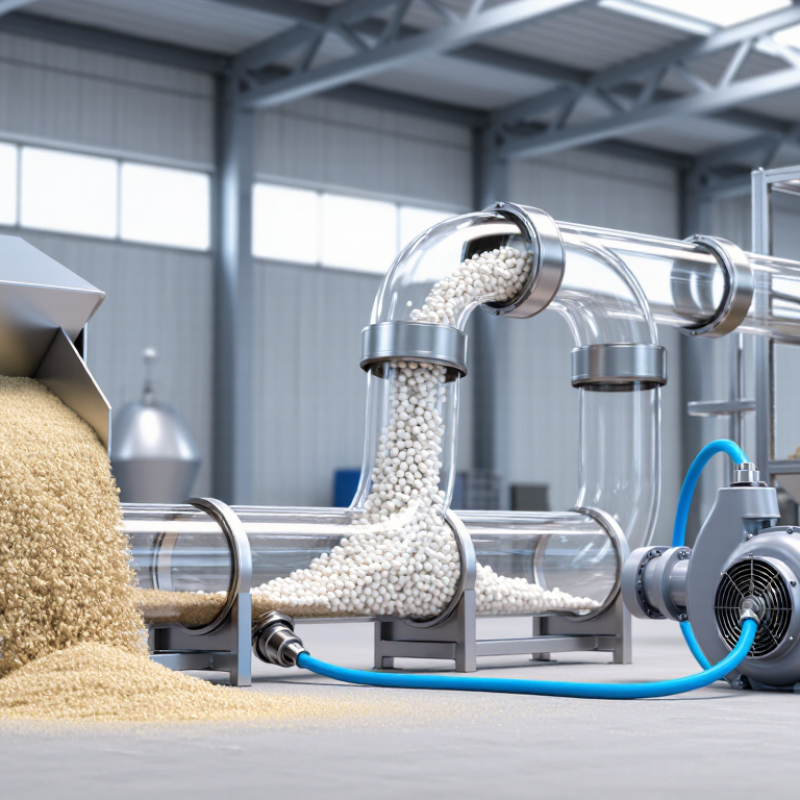
A pneumatic conveyor moves bulk solids by suspending or pushing them through a sealed pipeline with air. A blower or compressor creates the airflow; a feeder introduces material into the line. At bends, particles change direction, and pipe walls take the wear. The principle is simple. Yet powder does not travel like water.
In dilute-phase systems, particles ride at relatively high air speeds. David Mills’s Pneumatic Conveying Design Guide describes typical dilute-phase velocities in the range of roughly 15–30 m/s, while dense-phase conveying uses slower, material-dependent flow. These are guide values, not guarantees: particle size, moisture, pipe layout, and feed rate can shift the operating window. Too little air may let solids settle. Too much can increase abrasion and product damage.
Air has a cost. The U.S. Department of Energy’s Improving Compressed Air System Performance sourcebook reports that compressed-air systems use about 10% of industrial electricity, with higher shares at some plants. That figure covers compressed air broadly, not pneumatic conveying alone. Still, it makes leakage, pressure settings, and idle running worth checking. A clear pipe design can look efficient on paper; real powders are less predictable, and that deserves a test run.


