Let’s discuss your container requirements
01708 225350
Call Us
sale@modularmarbles.com
Email Us

7 Tips for Choosing a Custom ABS Electronics Enclosure

Choosing a custom ABS electronics enclosure involves more than finding a box that fits a circuit board. The enclosure must protect components, allow practical assembly, and support the product’s intended environment. A connector placed only a few millimeters off can complicate cable routing or leave too little room for a screwdriver. Small details matter.

ABS is valued for its balance of impact resistance, weight, and molding flexibility. Still, it is not the right answer for every product. Heat, chemical exposure, and outdoor use can change what material or design makes sense. There is no universal specification that works for every project. A tidy CAD model can also hide awkward assembly steps, so drawings deserve a hands-on review.

This guide presents seven practical tips for selecting and specifying a custom ABS electronics enclosure. It covers dimensions, wall thickness, mounting features, ventilation, surface finish, manufacturing methods, and supplier communication. Each choice should connect to a real requirement, such as a board’s clearance, a display’s viewing angle, or the force applied to a snap-fit lid. Some trade-offs are easy to miss until a prototype is in hand. That is not a failure; it is useful feedback. Clear measurements, realistic prototypes, and careful questions can help teams reduce avoidable revisions and choose an enclosure that works beyond the screen.
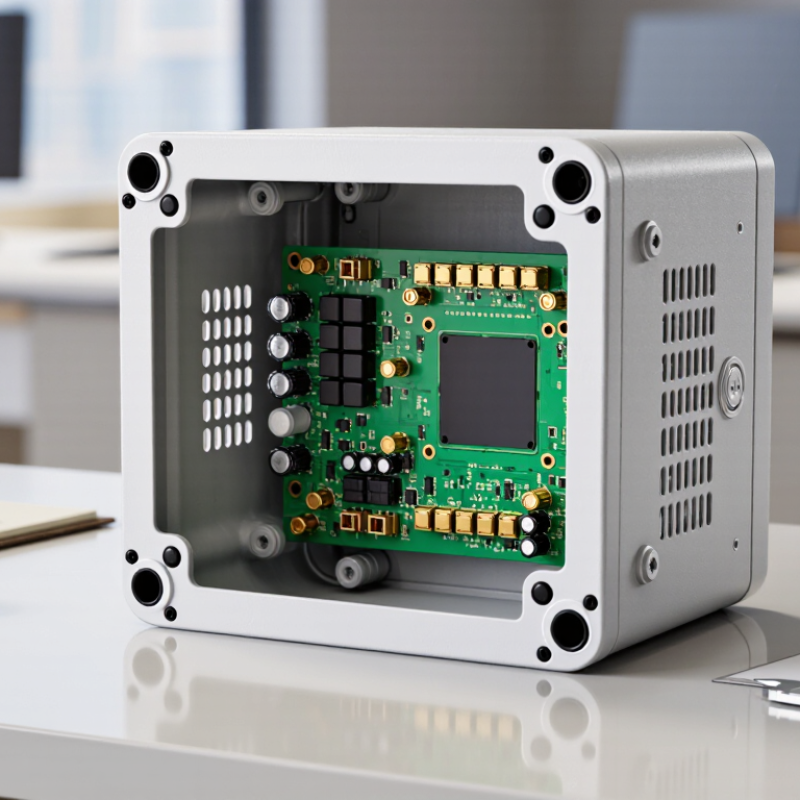
7 Tips for Choosing a Custom ABS Electronics Enclosure

Define Circuit, Connector, and Mounting Needs Before Choosing an ABS Enclosure

Before selecting a custom ABS enclosure, map the circuit board, heat-producing components, and service access. Record the board’s length, width, tallest component, and keep-out zones. Leave room for wiring bends, not just the connector body. In practice, a plug may fit the panel opening while its cable collides with a nearby wall. Small detail. Big consequence.

List every connector by type, location, and insertion direction. Then check whether users need space for fingers, tools, or a locking tab. IEC 60529 defines IP ratings; its IP54 classification means dust protection and protection against splashing water. That rating can guide decisions about openings, but it does not guarantee a finished enclosure’s performance. Seals, cable glands, and assembly quality matter too. See IEC 60529.

Mounting needs deserve the same care. Mark screw bosses, clips, rail mounts, and any access needed for installation. IPC-2221B, Generic Standard on Printed Board Design, provides board-design guidance that helps teams assess spacing and layout before enclosure tooling begins. Share those dimensions with the enclosure designer, including tolerances and the intended mounting surface. A drawing can look complete and still miss a screw head or cable bend. Review the physical assembly, if possible, before approving the final design.

Compare ABS Grades Using Typical Density of 1.04 g/cm³ and Tensile Strength Near 40 MPa

ABS is a practical choice for electronics enclosures because it balances impact resistance, machinability, and cost. A typical density of 1.04 g/cm³ helps estimate enclosure weight: multiply the material volume by this figure, then allow for openings, ribs, and bosses. Small differences matter. Treat the number as a planning value, not a guarantee; grade, additives, and processing can change the finished part.

Tip: Compare grades using tensile strength near 40 MPa as a reference point. Then check each supplier’s datasheet for test method, temperature, and conditioning. Tensile strength describes resistance to pulling, but it does not predict impact performance or heat resistance by itself. A thin wall around a screw post may crack even when the bulk material meets the target.

For a custom enclosure, check the load paths around mounting holes and connector cutouts. Ask for molded samples when dimensions or snap fits are critical. Feel the latch, inspect the edges, and test assembly with the actual board.

Not the whole story. If the unit will sit near warm components or in sunlight, compare heat and weathering data too. I would not choose a grade from density and tensile strength alone; those two values narrow the field, but real-use testing can still reveal surprises.

Set Wall Thickness and Mold Shrinkage Allowance, Typically 0.4–0.7% for ABS

ABS wall thickness affects strength, weight, cooling time, and the finish around visible surfaces. For many compact electronics enclosures, designers begin with a reasonably uniform wall, often around 1.5 to 2.5 mm, then adjust for load and geometry. The right value depends on the part, resin grade, and molding process. Keep walls consistent where possible. Sudden thick sections can cool unevenly and leave sink marks near screw posts or connector openings. Ribs can add stiffness without making the whole wall thicker, but overly tall or heavy ribs may create defects too. Small details matter.

Allow for ABS mold shrinkage when sizing the tool. A typical planning range is 0.4–0.7%, but it is not a fixed rule. Resin formulation, flow direction, part design, and processing conditions can shift the result. For example, a 100 mm feature may need roughly 0.4–0.7 mm of compensation as an initial estimate. Confirm the resin supplier’s data and review similar molded parts before finalizing dimensions. Then measure first-off samples, especially across long edges and around bosses. A first estimate is still only an estimate. Honestly, teams sometimes discover that a neat CAD model behaves less neatly in the mold; leave room for measured corrections before approving production tooling.

ABS Enclosure Design: Mold Shrinkage Allowance

A typical preliminary linear shrinkage allowance for ABS is 0.4–0.7%. Actual shrinkage depends on the resin grade, part geometry, tooling, and processing conditions. Keep enclosure walls as uniform as practical and confirm the allowance with the material supplier and mold maker.

Select an IEC 60529 IP Rating: IP54 Limits Dust Ingress and Resists Water Splashes

When choosing a custom ABS electronics enclosure, treat IP54 as a practical protection level, not a promise of complete sealing. Under IEC 60529, the first digit means dust ingress is limited; some dust may enter, but it should not interfere with operation. The second digit indicates resistance to water splashes from any direction. It is not designed for immersion or sustained water jets. Know the difference.

Look closely at the details around the enclosure. A lid seam, screw opening, cable gland, or poorly fitted connector can become the weak point. Ask whether the IP rating applies to the complete, assembled enclosure, including its installed cables and accessories. A gasket that looks thick may still compress unevenly if the lid is overtightened. That is easy to miss. Check the manufacturer’s test documentation, then consider how the unit will be mounted and cleaned in real use. If dust is especially fine or splashing is frequent, IP54 may not provide enough margin. Also, the rating does not measure impact resistance, chemical exposure, or UV durability, so assess those conditions separately.

Check Fire and Heat Requirements Against UL 94 Ratings and Grade-Specific Data

A flame rating is useful only when it matches the enclosure’s actual wall thickness. Under UL 94, a V-0 specimen must stop burning within 10 seconds after each flame application. Across ten applications, total afterflame time must not exceed 50 seconds, and flaming particles must not ignite the cotton indicator (UL 94, Tests for Flammability of Plastic Materials for Parts in Devices and Appliances). Check the exact resin grade, color, and tested thickness in its certification data; a thinner enclosure wall may not share the rating. Small details matter.

Heat needs a separate check. UL 746B evaluates long-term thermal aging and provides Relative Thermal Index values for specific properties, such as electrical or mechanical performance. RTI is not a short-term maximum temperature rating. Compare the relevant RTI with expected operating temperatures near components, vents, and sunlit surfaces, then review the grade’s technical data. I’ve seen designs rely on a resin family name when the selected grade had different test data. Easy to miss. UL 94 and UL 746B data describe tested material specimens, not every finished enclosure, so allow for real wall thickness, molding variation, and ventilation. That distinction deserves another look.

We are proud to support

Registered Company Name: Upminster Containers Limited. Registered Address: Mardyke Works, St Mary's Lane, Upminster, Essex RM14 3PA. Registered Company Number: 00940382
Developed & Maintained By Space Rocket Digital.
chevron-down