What Are the Top 10 Types of Scooter Motors?
Choosing a scooter motor is not just a matter of picking the highest wattage. The right design affects hill starts, range, noise, maintenance, and how confidently a scooter carries its rider. Scooter Motors come in several forms, and their names can overlap: a motor may be brushless, geared, and built into a wheel at the same time. That can make comparisons confusing.
This guide introduces ten common motor types and explains what distinguishes them in practical use. It considers brushed and brushless DC motors, hub and mid-drive layouts, geared and direct-drive designs, and other specialized options. The details matter. A geared hub motor may feel responsive when pulling away, while a direct-drive unit has fewer moving parts inside its casing. On a steep street, torque and heat management can matter more than a headline power figure. On a flat commute, efficiency and quiet operation may deserve greater attention.
Specifications alone do not tell the whole story. Battery voltage, controller limits, wheel size, rider weight, and terrain all shape real-world performance. A warm motor housing after a long climb is a useful observation, but it is not a precise diagnostic test. Small caveat. Some categories also describe construction, not entirely separate motor families, so any top-ten list has limits. The aim here is not to declare one universal winner, but to help readers compare designs, ask better questions, and match a motor to the way a scooter will actually be used.
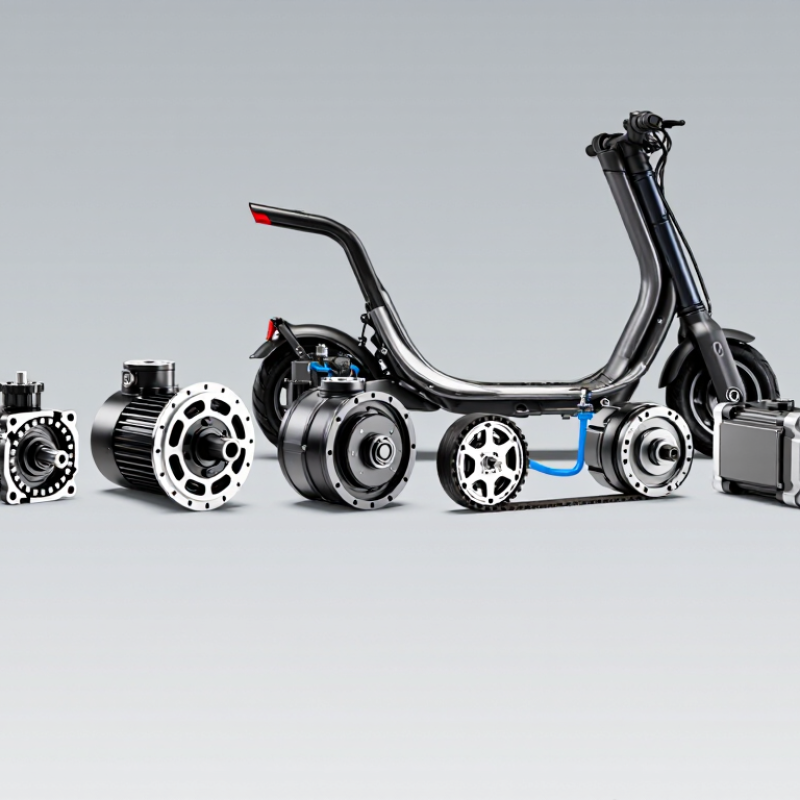
How Scooter Motors Are Classified by Current, Design, and Placement
Scooter motors are best classified along three axes: electrical current, mechanical design, and placement.
These labels overlap, so ten categories are useful reference points, not ten completely separate motor types. Brushed DC motors use brushes to transfer current, while brushless DC motors use electronic control and avoid brush wear. AC induction motors create rotation through an alternating magnetic field. The controller and battery must match the motor’s electrical requirements. Check the motor rating, not just its advertised power.
Mechanical designs include geared hub motors, direct-drive hub motors, mid-drive motors, chain-drive motors, belt-drive motors, and friction-drive motors.
Geared hubs use internal reduction gears for compact torque; direct-drive hubs have fewer moving parts but can feel heavier. Mid-drive motors send power through the drivetrain, while chain and belt systems connect a motor to a wheel. Friction drives press a roller against the tire.
Small details matter. Hub motors may sit in the front or rear wheel, changing weight distribution and traction. A front-mounted unit can affect steering feel; a rear-mounted one can load the driven wheel.
The categories overlap. A rear hub motor, for example, may also be brushless and geared. That makes a tidy ranking slightly artificial, but checking all three axes helps compare real scooters.
Brushed DC, Brushless DC, and Permanent-Magnet Synchronous Motors
Brushed DC, brushless DC (BLDC), and permanent-magnet synchronous motors (PMSMs) are common scooter motor architectures. A brushed motor uses carbon brushes and a commutator. Its controls are simple, but contact wear can require maintenance. BLDC motors use electronic switching instead, reducing brush-related upkeep. PMSMs also use permanent magnets, often with sinusoidal control for smooth, precise operation. The labels can overlap: controller waveform and motor design matter. On a steep hill, cooling and gearing may matter as much as the motor name.
The U.S. Department of Energy’s 2014 motor-systems sourcebook reports that motor-driven systems account for about 68% of U.S. manufacturing electricity use. That figure is not scooter-specific, but it shows why motor efficiency deserves attention. For scooters, compare continuous power, controller compatibility, thermal protection, and service access. Peak wattage alone can mislead. Repeated starts and a hot, enclosed hub can expose weak thermal design. Ask for test conditions or efficiency data; results vary with load, speed, and temperature.
Tips: Check the motor and controller as a matched pair. Test with a rider’s load, not an unloaded wheel. Record the motor’s rated voltage and continuous power.
10 Common Scooter Motor Types and Configurations
Indicative typical peak motor-efficiency ranges (%). Actual efficiency varies with motor design, operating load, controller, and cooling.
Hub-mounted and mid-drive describe motor placement rather than a distinct electromagnetic motor type. The ranges are approximate comparisons, not guaranteed specifications.
Geared Hub, Gearless Hub, and Direct-Drive Motors
A geared hub motor uses internal reduction gears to turn the wheel. This lets a relatively small motor produce useful torque when starting or climbing. You may notice a light whir as the gears spin. The design can keep the motor compact, but its moving parts may wear over time. Heavy loads, steep hills, and frequent stop-and-go riding can increase that wear. A test ride matters; specifications alone do not reveal every sound or vibration.
A gearless hub motor has no internal reduction gears, so its construction is often simpler. It can feel smooth and quiet on level roads, though the motor may be heavier and less lively at low speeds. Direct-drive usually refers to a gearless hub motor that turns the wheel without a gear reduction. The terms can overlap, which is worth noticing when comparing product descriptions. Quiet, but not weightless. For daily use, check the motor’s stated power, the scooter’s total load rating, and how it behaves on the hills you actually ride. I would not judge efficiency from motor type alone; controller settings, wheel size, and riding conditions also matter.
Mid-Drive, AC Induction, and Switched-Reluctance Motors
What Are the Top 10 Types of Scooter Motors? Mid-Drive, AC Induction, and Switched-Reluctance Motors
“Mid-drive” describes motor placement, not an electrical motor type. A mid-drive sends power through the scooter’s gearing, which can help maintain useful torque on hills. It also adds moving parts and may need more maintenance. A hub motor is simpler, but wheel weight can affect handling. The best choice depends on terrain, load, speed, and service access. Small details matter.
AC induction motors use a rotating magnetic field and avoid permanent magnets. They are robust, but their control systems can be more demanding than those of common permanent-magnet motors. Switched-reluctance motors use a toothed rotor drawn toward energized stator poles. Their simple rotor is appealing; torque ripple and audible noise can be drawbacks. The U.S. Department of Energy’s Improving Motor and Drive System Performance sourcebook stresses matching motor, drive, and load—an important principle for scooters, too. The IEA’s Global EV Outlook 2024 estimates that about 9 million electric two- and three-wheelers were sold worldwide in 2023, making efficient, reliable designs increasingly relevant. That figure does not identify motor types, so it should not be treated as proof that one design dominates. I’d still want to test a scooter on a real hill before trusting a specification sheet.
Axial-Flux and Radial-Flux Motors: Design and Performance Differences
What Are the Top 10 Types of Scooter Motors?
Axial-Flux and Radial-Flux Motors: Design and Performance Differences
Axial-flux and radial-flux describe how magnetic flux crosses a motor’s air gap. In an axial-flux design, it travels parallel to the shaft. This often produces a flat, disc-like motor, which can fit neatly into a wheel or a shallow frame space. The wider layout may deliver strong torque for its size, but packaging, cooling, and manufacturing details still matter. A compact shape does not guarantee an efficient scooter.
Radial-flux motors direct magnetic flux across the gap, roughly toward the shaft. Their cylindrical geometry is widely understood and can be easier to integrate with conventional motor housings. Depending on the design, they may also offer practical heat paths and reliable operation during repeated acceleration. Not always. Performance depends on the complete system, including winding design, magnets, controller settings, and airflow.
For a scooter, the useful comparison starts with the actual ride. A heavy rider climbing a long hill creates a different thermal load than a light rider cruising on level pavement. Axial-flux may suit a tight, flat installation; radial-flux may suit a deeper cylindrical space. Check continuous power and temperature behavior, not just peak torque. A tidy specification sheet can still hide real-world limits, and I would want test data under conditions close to my commute.


