Let’s discuss your container requirements
01708 225350
Call Us
sale@modularmarbles.com
Email Us

Top Bar Height Tables Manufacturers in China?

Bar Height Tables are more than tall tops on four legs. Their stability, finish, and seat compatibility shape how well they work in cafés, hotels, and home kitchens. For buyers comparing manufacturers in China, the hard part is separating attractive catalog photos from reliable production details.

Grand View Research valued the global furniture market at USD 677.09 billion in 2023 and projected 5.0% annual growth from 2024 to 2030. This is a broad furniture-market measure, not a bar-table sales estimate. Still, it shows the scale of a competitive sector where sourcing decisions matter. The report does not tell buyers which factory will deliver consistent welds, even finishes, or dependable packaging. Those details need direct verification.

The design principle is simple. “The details are not the details. They make the design,” furniture designer Charles Eames famously said. For a bar-height table, details include a level base, a clean edge, and a finish that holds up to daily contact. Small things count. Buyers should ask manufacturers for material specifications, load-test information, sample lead times, and clear production photographs. A sample can reveal more than a polished brochure, though one sample cannot prove every future batch will match. That is an imperfect check, but a useful one. This guide introduces leading Chinese manufacturers and practical questions to ask before requesting a quotation.
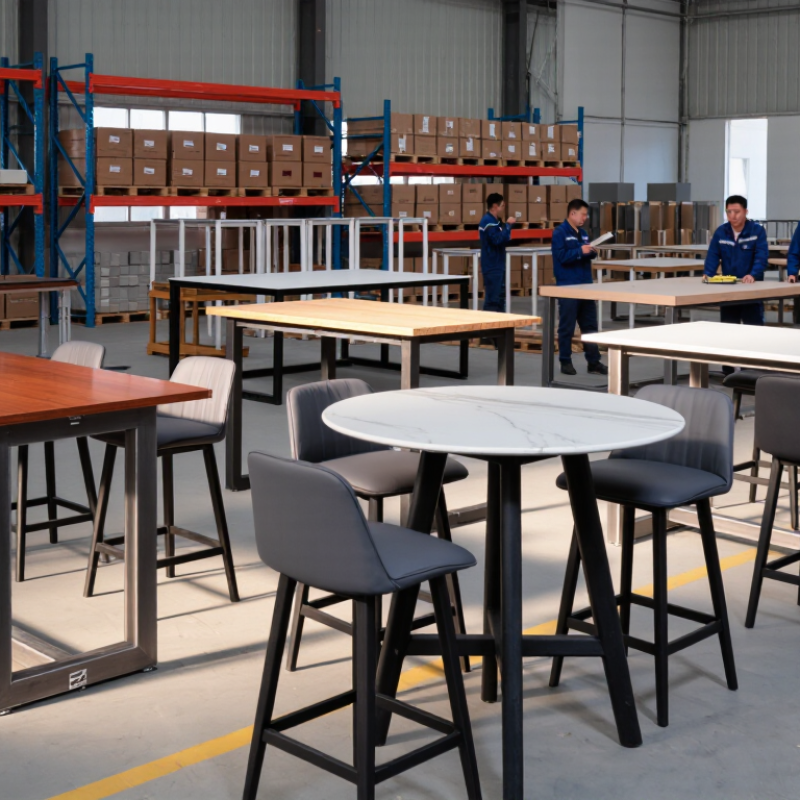
Top Bar Height Tables Manufacturers in China?

Understanding Bar-Height Tables and Their Common Applications

Bar-height tables usually measure about 40 to 42 inches tall, though dimensions vary by design. They pair with stools made for elevated seating and create a more casual, open feel. In cafés, hotel lounges, and home kitchens, they can define a gathering spot without needing a full dining setup. A narrow table works well beside a window or along a counter. Larger tops give guests more room for plates, drinks, and shared snacks. Check the table height against the actual stool seat; even a small mismatch can make long meals uncomfortable.

Tips: Measure the floor space and stool height before ordering. Ask manufacturers in China for confirmed dimensions, materials, finish details, and load capacity. Requesting a sample finish can help you judge color and texture in your own lighting.

Applications depend on how people use the room. A sturdy, easy-to-clean surface suits busy cafés, while a smaller table may fit a breakfast nook. For shared spaces, consider a stable base and enough legroom beneath the top. Wood can bring warmth, while metal or compact laminate may suit higher-traffic settings, depending on construction and care needs. Some layouts look attractive in a showroom but feel crowded in daily use. Leave room for stools to slide out and for people to pass comfortably.

Top Bar Height Tables Manufacturers in China? - Understanding Bar-Height Tables and Their Common Applications

The specifications below describe common bar-height table formats and applications. Dimensions are typical planning ranges; actual sizes, materials, finishes, and load ratings vary by product and supplier.

Table Type Typical Height Common Top Size Typical Seating Common Materials Common Applications Useful Selection Considerations
Round café bar table 40–42 in (102–107 cm) 24–36 in (61–91 cm) diameter 2–4 people Solid wood, engineered wood, laminate, steel base Cafés, casual dining areas, hotel lounges Allow comfortable elbow room and check that the base does not obstruct stools.
Square bar table 40–42 in (102–107 cm) 24–36 in (61–91 cm) per side 2–4 people Laminate, wood, compact laminate, metal base Bars, small restaurants, break areas Square tops can be arranged efficiently in rows and are practical for compact floor plans.
Rectangular communal table 40–42 in (102–107 cm) 48–96 × 24–36 in (122–244 × 61–91 cm) 4–8 people Solid or engineered wood, laminate, steel or timber base Food halls, shared dining, collaborative workspaces Check the table length, leg placement, and circulation space for stools on both sides.
Outdoor bar table 40–42 in (102–107 cm) 24–36 in (61–91 cm) diameter or square 2–4 people Powder-coated aluminum, stainless steel, treated wood, outdoor-rated compact laminate Patios, terraces, outdoor cafés and bars Specify weather-resistant finishes and confirm suitability for the intended climate and exposure.
Adjustable-height table Typically adjusts across counter and bar heights Commonly 24–36 in (61–91 cm) wide or diameter Usually 2–4 people Steel or aluminum column, laminate or wood top Flexible dining areas, event venues, multipurpose rooms Review adjustment mechanism, stability at maximum height, and the available height range.
Counter-height table 34–36 in (86–91 cm) Commonly 24–36 in (61–91 cm) wide or diameter 2–4 people Wood, laminate, metal, or mixed materials Kitchen islands, casual dining, breakfast areas This is lower than standard bar height; pair it with counter-height seating rather than bar stools.
Bar-height table with pedestal base 40–42 in (102–107 cm) Commonly 24–36 in (61–91 cm) diameter or square 2–4 people Wood or laminate top with cast-iron or steel base Restaurants, pubs, waiting areas Base weight and footprint affect stability; verify compatibility with the selected tabletop size.

General seating guide: bar-height tables are commonly around 40–42 in (102–107 cm) high and are typically paired with stools with seats about 28–30 in (71–76 cm) high. Confirm table and stool dimensions together before ordering.

Key Design Features, Materials, and Height Standards

A bar table should fit the way people use it, not just match a catalog photograph. Most standing-height models measure about 101 to 107 centimeters from floor to tabletop. Pair them with stools whose seats sit roughly 25 to 30 centimeters below the surface. That gap gives knees room and keeps elbows comfortable. Still, these figures are starting points. A thick tabletop or an unusually tall user can change the feel.

Design details matter. Small details matter. A stable base, well-finished welds, and a sturdy footrest can make daily use more comfortable. Metal frames suit busy spaces, while solid wood adds warmth and visible grain. Engineered boards can offer a more consistent finish, but edge sealing deserves close attention. Stone tops are heavier, so the frame must support their weight without wobbling. Ask manufacturers how they check table stability, surface finish, and material moisture before shipment. Measurements on drawings can be precise; real floors are not always level. I would still test a sample with the intended stools before confirming a large order. That step takes time, but it can reveal an awkward reach or a footrest set too high.

How Bar-Height Tables Are Manufactured in China

Manufacturing bar-height tables in China starts with a specification, not a welding torch. Buyers define the finished height, top dimensions, load needs, and materials; engineers then convert these into drawings and cutting lists. A bar-height design is often around 40–42 inches, but the exact dimension should match the intended stools and user setting. Small errors matter.

For steel bases, factories cut tube or plate, form the legs, and weld the frame in a jig to keep it square. Welds are ground smooth before surface preparation and powder coating. China produced 1,019.1 million tonnes of crude steel in 2023, according to World Steel Association’s World Steel in Figures 2024. That figure shows the scale of the country’s steel industry, though it does not guarantee consistent table quality. Inspecting welds, coating coverage, and leg stability still matters.

Wood or engineered-wood tops are cut, edged, drilled, and finished before assembly. The USDA Forest Products Laboratory’s Wood Handbook explains that wood changes dimension as its moisture content shifts below the fiber saturation point, typically near 30 percent. Manufacturers therefore need controlled drying and suitable storage. This step is easy to rush, and later warping can expose it. Final checks should include table height, wobble on a level floor, fastener fit, and packaging protection. Not glamorous, but essential.

Types of Chinese Manufacturers and Their Product Specialties

Chinese top bar height table manufacturers generally fall into three groups. Contract furniture factories focus on welded steel frames, cast-iron bases, and repeatable dimensions for restaurants and hotels. Wood-focused workshops offer solid timber, veneer, and custom edge profiles. Export-oriented assemblers combine metal bases with compact-laminate or stone-look tops, often adapting packaging and finishes for overseas orders.

A typical bar-height top is about 40–42 inches high, but confirm the finished table height and stool clearance together.

CSIL’s World Furniture Outlook identifies China as the world’s largest furniture producer, with roughly two-fifths of global output. Statista Market Insights values China’s furniture market at around US$80 billion in 2024; this broad figure does not isolate bar tables, but it signals a deep supplier base.

Ask factories for frame-gauge details, tabletop thickness, load-test records, and finish samples—not only catalog photos. A limitation: sample quality may not match a full production run. Request a pre-shipment inspection and check whether replacement parts are available.

Export assemblers can simplify mixed-material sourcing, while specialist workshops may offer more control over joinery or metalwork. The trade-off is real. A low quoted price can hide thin tubing, uneven welds, or poorly sealed edges.

How to Evaluate and Source a Bar-Height Table Manufacturer in China

Sourcing a bar-height table manufacturer in China requires more than comparing quoted prices. Start with the intended setting: a busy café, a hotel lounge, or a covered patio. Confirm the table height, top dimensions, base footprint, and expected daily use. Ask whether the manufacturer can provide material specifications, finish samples, and drawings before production. A sample can reveal details a catalog photo cannot, such as a sharp edge or uneven coating.

Evaluate construction with specific questions. What is the tabletop made from? How are the legs joined, and how is wobble checked? Request recent inspection records or a clear description of load and stability tests. Check production capacity, lead times, packaging methods, and how defects are handled. Compare quotes line by line; vague terms can hide differences in materials or included services. A tidy spreadsheet helps, but it may still miss practical details.

Tips: Send one drawing with exact measurements and finish requirements. Ask for close-up photos of joints and table edges. Confirm sample and bulk orders use the same materials. Keep communication in writing. I have learned that quick replies feel reassuring, but they do not prove consistent quality; verify claims with documents and a physical sample where possible.

We are proud to support

Registered Company Name: Upminster Containers Limited. Registered Address: Mardyke Works, St Mary's Lane, Upminster, Essex RM14 3PA. Registered Company Number: 00940382
Developed & Maintained By Space Rocket Digital.
chevron-down