
Choosing a reliable Chinese supplier for a Fluorocarbon Coated Aluminum Window takes more than comparing prices or attractive product photos. Buyers should check the manufacturer’s production experience, coating process, quality records, and ability to provide project-specific documentation. A well-finished sample can show color consistency, smooth edges, and neat corner joints. It cannot, by itself, prove long-term performance.
This guide introduces practical ways to assess suppliers and compare their capabilities. It considers product specifications, customization, communication, delivery planning, and after-sales support. Ask how the coating system is applied and what inspection steps are used. Request clear information about aluminum profiles, hardware, glass options, and applicable test reports. Details matter. A supplier may offer a broad catalog, while having limited experience with a particular window design. That difference can be easy to miss.
For a fair comparison, describe the intended building, operating conditions, and project requirements before requesting quotations. Then review each response for precise dimensions, stated materials, and realistic lead times. Where possible, arrange a factory review or have samples examined by a qualified third party. These checks do not remove every risk. They do make assumptions easier to spot. Even experienced buyers can overlook small inconsistencies, so a careful checklist is useful. No shortlist is perfect, and the best choice depends on the project rather than a supplier’s ranking alone.
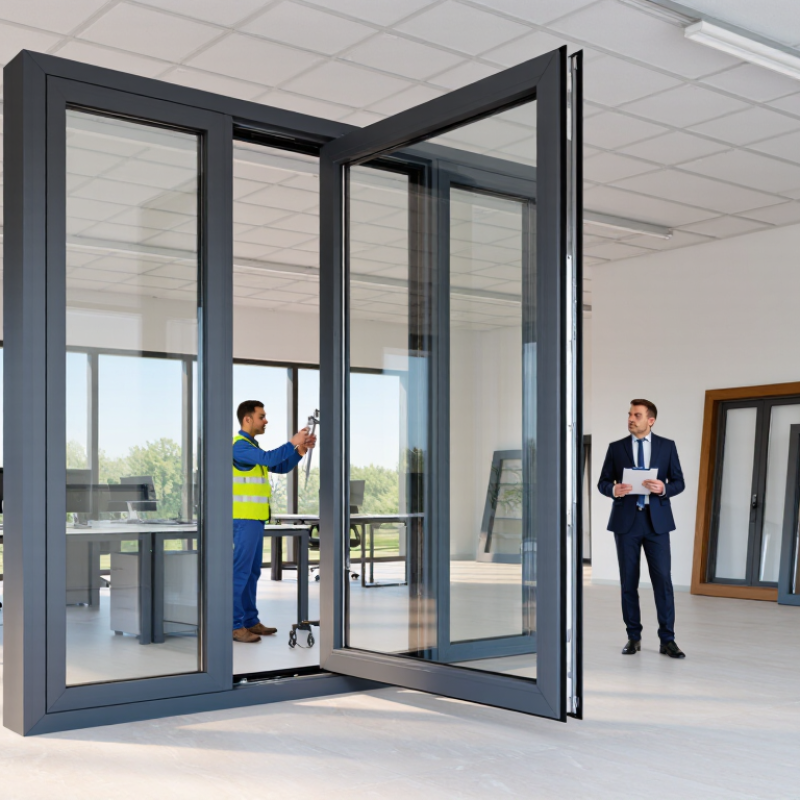
A fluorocarbon-coated aluminum window has an aluminum frame finished with a fluoropolymer-based coating, often using PVDF resin. The coating is applied and cured to create a durable exterior surface. It helps the frame resist fading, chalking, and weather exposure while preserving its color. You may notice the finish most clearly on a sun-facing frame: it should remain more even than an ordinary paint finish, though real-world results depend on preparation and maintenance.
This coating does not make a window energy-efficient by itself. The U.S. Department of Energy’s Energy Saver guidance estimates that windows account for about 25–30% of residential heating and cooling energy use. Glass type, seals, installation, and thermal breaks in the frame all affect performance. That matters. For coating quality, AAMA 2605-22 sets demanding performance requirements for high-performance organic coatings on architectural aluminum, including weathering and corrosion testing. It evaluates the finish, not the complete window’s insulation. Buyers should check the coating specification alongside glazing and frame details. A strong finish is useful, but it is not a substitute for a well-designed window.
Fluorocarbon-coated aluminum windows use aluminum frames finished with a fluoropolymer-based coating. Supplier capabilities and product specifications vary, so compare documented coating performance, window-system details, quality controls, and project suitability rather than relying on a general product label.
| Comparison Dimension | Factual Information | What to Verify with a Supplier |
|---|---|---|
| Coating Type | “Fluorocarbon” describes a family of fluoropolymer coatings. Architectural products may use different resin chemistries, including PVDF- or FEVE-based systems; the term alone does not identify a specific formulation. | Request the coating manufacturer’s product data sheet, resin type, application method, and the exact coating system proposed for the window profiles. |
| Coating Performance Standard | AAMA 2605 is a widely used specification for high-performance organic coatings on architectural aluminum. A reference to a standard should be tied to the applicable edition and tested coating system. | Ask for current test reports or other substantiation identifying the coating system, substrate, test scope, and applicable standard. Do not treat a standard reference as proof that every window component is certified. |
| Weathering and Color Retention | Outdoor coating durability depends on the specified coating system, color, exposure conditions, surface preparation, and application quality. A coating specification does not make all colors or installations perform identically. | Confirm the proposed color and gloss, available weathering data, project exposure assumptions, and warranty coverage and exclusions for fading or chalking. |
| Aluminum Frame and Thermal Break | The exterior finish does not determine a window’s thermal performance. Frame design, any thermal break, glazing, seals, and installation all affect whole-window performance. | Request section drawings, frame and thermal-break details, glazing options, and whole-window performance data for the configuration being quoted. |
| Air, Water, and Structural Performance | Window performance depends on the complete tested assembly and its size, opening style, glazing, and hardware—not on the coating alone. | Ask for test reports for the relevant window type and configuration, including the test methods, specimen size, and reported results. |
| Fabrication and Quality Control | Cutting, machining, assembly, handling, and installation can affect finished-window quality. Coating inspection alone does not establish the performance of the assembled window. | Review documented inspection procedures, production traceability, sample or mock-up approval, and checks for coating damage after fabrication. |
| Maintenance and Repair | Routine cleaning helps remove dirt and pollutants. Cleaning agents and repair methods should be compatible with the specific finish; abrasive materials can damage coated surfaces. | Obtain written cleaning instructions, approved repair procedures, and guidance for evaluating damage to the finish. |
| Supplier Documentation and Warranty | Warranty length, covered components, remedies, and exclusions vary by supplier and product. A coating warranty and a window-system warranty may be separate. | Compare written warranties, production lead time, packaging and shipping arrangements, spare-parts support, and the documents supplied with the order. |
Selection note: Compare suppliers using project-specific drawings, verified test documentation, coating-system details, and written warranty terms. Confirm that quoted test results apply to the window configuration and finish required for your project.


